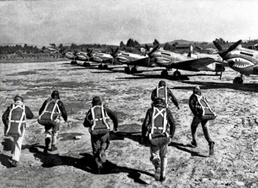
MOODY AIR FORCE BASE, Ga. -- More than 120 years ago, on the windswept dunes of Kitty Hawk, two brothers from Ohio changed the world with a 12-second flight. Today, the legacy of Orville and Wilbur Wright extends far beyond that moment in 1903. It stretches across generations of Airmen and into the history of one of America’s most iconic combat aviation units, the Flying Tigers.
As global tensions mounted and aviation technology rapidly advanced, the United States began to rethink the role of aircraft in modern warfare. This shift set the stage for the growth of the U.S. Army Air Corps, which expanded significantly following World War I and throughout the 1930s. By the onset of World War II, airpower had become central to America’s military strategy. During this period, evolving tactics, intensive pilot training and a growing belief in the strategic value of air superiority produced a group of skilled aviators prepared to serve wherever they were needed.
Between 1940 and 1941, China faced increasing pressure from Japanese expansion across East Asia. Seeking assistance, the Chinese government turned to the United States. Retired U.S. Army Air Corps officer Claire Lee Chennault answered the call, proposing the formation of an American fighter unit to support Chinese forces. This organization would become known as the American Volunteer Group (AVG).
Mark Godwin, 23d Wing historian, explained that while Chennault’s fighter-focused ideas challenged prevailing U.S. Army Air Forces doctrine, they ultimately helped shape more effective combat tactics.
“Chennault is very important to the story,” Godwin said. “He argued strongly for the pursuit aviation. He believed fighters were essential to defend our bases, protect our bombers, and take the fight to the enemy by striking their airfields. At the time, however, the Army Air Forces was largely focused on high-altitude bombers and the belief that they could reach enemy targets and stop attacks before they began.
“Chennault challenged that thinking, but his ideas weren’t well received,” Godwin continued. “In 1937, he was effectively pushed out of the military as a major. He went to China, where he became Chiang Kai-shek’s right-hand man and served as a liaison in the effort to build a modern Chinese Air Force. In 1939, Chennault returned to Washington, D.C., seeking support for fighters, bombers and transport aircraft for what would become the American Volunteer Group. The president approved the effort, and Chennault was provided 100 P-40 aircraft which was considered outdated by some at the time. Using the very tactics the Army Air Forces had dismissed, he trained Chinese pilots and later the AVG. The results were remarkable, and the success of the American Volunteer Group spoke for itself.”
In 1941, the AVG earned its legendary nickname, the Flying Tigers. Composed primarily of pilots and maintainers from the U.S. Army Air Corps, Navy and Marine Corps, the unit faced overwhelming odds. Though often outnumbered and operating with limited resources, the Flying Tigers flew the Curtiss P-40 Warhawk, an aircraft rugged and well-suited to Chennault’s tactics. Through innovative combat techniques, including disciplined formations, hit-and-run attacks and the deliberate use of mutual-support tactics that would later evolve into the modern wingman concept, the unit overcame technological and numerical disadvantages.
“Innovation was the reason for their success,” Godwin said. “When the American Volunteer Group was active, their supply chain was limited, so they often had to cannibalize parts from other aircraft just to make one mission-capable. If a needed part wasn’t available, they would fashion it themselves from sheet metal. They were doing remarkable things with minimal resources while ensuring the mission continued.
“Chennault had two groups he called the ‘Flying Trapezers,’ and while they were performing acrobatics, he was also teaching fighter tactics,” Godwin added. “Back then, air combat wasn’t about heat-seeking missiles, it was man and machine, trying to put bullets on another piece of metal while staying alive yourself. Tactics like flying out of the sun gave pilots an advantage, and gaining altitude provided dominance, especially since the P-40 wasn’t very maneuverable. At higher altitudes and in dives, it could outperform a Japanese Zero. Chennault emphasized dive strafing and other techniques were just as important as the wingman concept like looking out for your partner in a dogfight. You weren’t alone because having someone watching your six significantly increased your chances of survival.”
The resilience and ingenuity of the Flying Tigers resulted in a remarkable combat record. The AVG successfully defended the Burma Road and key Chinese cities, achieving an exceptional kill ratio against Japanese aircraft. During this campaign, the P-40, adorned with its now-iconic shark mouth, became a lasting symbol of American airpower and resolve.
As Godwin put it, the shark-mouthed P-40s weren’t just iconic, they made their mark from the very first fight.
“On December 20, 1941, the American Volunteer Group experienced its first combat,” Godwin explained. “Japanese forces attempted to bomb a base where the AVG was stationed. The first and second pursuit squadrons got airborne and destroyed eight of the nine bombers targeting Kunming. The ninth bomber barely made it back to its base. With their P-40s marked with shark teeth, the AVG’s pilots demonstrated from the very start that they were capable and ready. This baptism by fire showed they meant business and knew what they were doing.”
In July 1942, the success of the AVG drew the attention of U.S. military leadership. The volunteer group was officially dissolved and became the 23d Fighter Group under the U.S. Army Air Forces, with Chennault continuing as its commander.
Based on interviews and his memoir Way of a Fighter, Chennault emphasized that success in the air depended on teamwork, tactical discipline and making the most of every advantage; the lessons he believed all future aviators must carry forward. He instructed pilots to “always look around, stay together, hit and get out so you can recover speed and come back,” underscoring the importance of coordinated effort over lone heroics.
As part of the China Air Task Force and later the Fourteenth Air Force, the Flying Tiger legacy endured throughout World War II. Their innovations helped validate modern fighter doctrine and underscored the critical role of airpower in the Pacific as well as coalition warfare.
The Wright Brothers’ pioneering work set the stage for the Flying Tigers, with their innovations shaping the tactics and training of American military aviation. From the Wright Flyer to the P-40, the story of pursuit aviation reflects decades of innovation and remarkable breakthroughs. The Flying Tigers were not only a testament to that legacy but also a symbol of American ingenuity and enduring partnership in the skies.