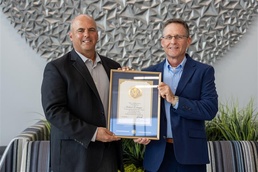
Whether it's hiking up Mount Whitney or briefing the Secretary of Defense, it's all in a day's work for Michael Stenger. A former marathon runner, he has had a marathon career, from supporting the legacy of the Sidewinder Missile to advancing new technologies and means of warfighting. Hired in 1985 as a technician, Stenger has made a significant impact in his 40 years with Naval Air Warfare Center Weapons Division.
"It's a remarkable story filled with a lot of hard work," said Dan Carreño, NAWCWD executive director, about Stenger's career. "He started as a mechanical engineering technician and stands here today as an SSTM."
Stenger serves as the Senior Scientific Technical Manager for Weapons Technology Development, a role that reflects decades of hands-on experience and leadership at NAWCWD.
This Ridgecrest native is a second-generation China Laker. His father accepted a position as an electrical engineer at China Lake and moved the family to the small desert town.
Stenger graduated from the local high school and, admittedly, was not the greatest student.
Stenger began his career with NAWCWD in the Sidewinder missile program, assembling seekers. During his time with Sidewinder, he was responsible for the Level 3 computer-aided design documentation of the mechanical configuration of the AIM-9R, whose imaging seeker later contributed to the present AIM-9X.
He went on to serve as the lead system engineer for the integration of the AIM-9M Sidewinder on the U.S. Air Force F-22 Raptor. Stenger and his team were responsible for the first live fire off that platform. In that effort he was responsible for the technical briefings to PMA-259 and the Air Force regarding integration, system qualification, and flight testing.
Stenger's legacy continues with his son, the third generation to work at NAWCWD in the Sidewinder missile program.
In addition to his work with the Sidewinder missile, Stenger also served as the lead technician for high off boresight missile seeker prototypes used in the development and evaluation of the Joint Helmet Mounted Cuing System for the F/A-18 and F-15. This effort contributed to another first in his career with AIM-9X integration with the F/A-18.
This laid the groundwork for his continued and vital role in technical management of the development and integration of weapon technologies.
After receiving his bachelor’s degree in computer science in 2002, Stenger combined his practical experience and engineering skills in the development, test and support of other U.S. Navy and joint service weapons. Stenger spent time working on other Navy weapons programs, across multiple mission areas. including target development efforts for the Fleet Supersonic Target.
Stenger said among his more enjoyable efforts with NAWCWD was the work leading the Novel Modernization Program Studies, which was focused on rapid prototyping to enhance existing fleet capabilities through development and maturation of technologies, tactics and improvements to existing weapon systems.
In this role, Stenger led the NAWCWD teams generating candidate proposals for solutions to Navy war fighting problems. Several NAWCWD initiatives were accepted, including one originated by Stenger.
He has led many teams and often has the same group move from program to program along with him.
"We are very fortunate to have a fantastic team, and we spend a lot of time together in a small workspace," Stenger said, "so it’s important that everyone can get along and is interested in the work."
Development and testing of new technologies and advancing capabilities so that the fleet is better prepared has been at the core of Stenger's career.
While his initial career was not exceptional, nor unique, through his hard work and dedication Stenger has carved out a career that is both exceptional and unique.
Stenger routinely interfaces with sponsors, and other agencies as a subject matter expert focused on improving capability for the fleet. He is often tagged to provide briefings to high-level visitors, including the Chief of Naval Operations and the Secretary of Defense.
"Mike is leading capability development for our nation," Carreño said.
Stenger said he's seen a lot of ships come and go and always had a good understanding of what the work is doing and why it is relevant.
While Stenger would someday like to get back to hiking and running marathons, he is content with his role in the nation's defense.
"Being able to provide relevant fleet capability," Stenger said, "is my proudest accomplishment."