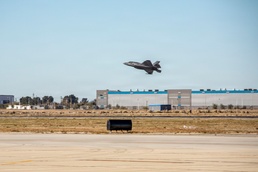
VICTORVILLE, Calif. — Marines with Marine Aerial Refueler Transport Squadron (VMGR) 352, Marine Aircraft Group 11, 3rd Marine Aircraft Wing, conducted an air-delivered ground refueling as part of exercise Steel Knight 25 at Southern California Logistics Airport, Victorville, California, Dec. 12, 2025. Steel Knight is an annual exercise that strengthens the Navy-Marine Corps team's ability to respond forward, integrate across domains, and sustain Marine Air-Ground Task Force readiness.
ADGR enables 3rd MAW to sustain distributed aviation operations by delivering fuel to forward locations without reliance on established infrastructure. For fifth-generation fighter jets such as the F-35B, this capability allows Marine aviation to operate farther forward, maintain tempo, and remain unpredictable in a contested maritime environment.
“ADGR is a refueling method that’s able to provide fuel in locations where no other source for fuel is readily available,” said Sgt. Zane Jaggers, a loadmaster with VMGR-352. “We can support fixed-wing, rotary-wing, and tactical ground vehicles without having to operate more complex refueling systems.”
During the evolution, a KC-130J Super Hercules with VMGR-352 headquartered at Marine Corps Air Station Miramar, California, was tasked with supporting multiple F-35B Lightning II aircraft with Marine Fighter Attack Squadron (VMFA) 214, MAG-13, 3rd MAW, headquartered at MCAS Yuma, Arizona. Operating aircraft from separate bases and sustaining them at a forward location demonstrated 3rd MAW’s ability to execute distributed aviation operations, enabling aviation units to generate combat power across dispersed locations while remaining connected through resilient command and control.
For the F-35Bs, the fuel delivered through ADGR directly translated to extended time on station, increased range, and the ability to support follow-on missions without returning to a main operating base. By refueling forward, the aircraft were able to remain engaged deeper into the battlespace, reinforcing 3rd MAW’s ability to generate combat power from dispersed locations.
Once the KC-130J landed, a two-point ADGR site was promptly set up. Once finished, the F-35Bs were then directed towards the ADGR site to receive fuel. From landing to the F-35Bs taking off, the whole evolution took approximately 40 minutes with the site teardown being completed within that time.
In total, the F-35Bs were topped-off with over 8,000 pounds of fuel. With an internal fuel capacity of approximately 13,000 pounds and a combat radius of 505 nautical miles, the 8,000 pounds of fuel represented roughly 60 percent of the aircraft’s internal capacity, significantly extending operational reach and allowing the aircraft to remain engaged forward without returning to a main operating base.
The Marines of VMGR-352 were able to showcase one of the many capabilities of the KC-130J, demonstrating the aircraft’s versatility and its vital role in supporting a wide range of Marine Corps operations.
“The KC-130J brings an all-in-one platform to the Marine Corps; it’s the Swiss Army knife we need,” Jaggers said.
This ADGR evolution reinforced 3rd MAW’s ability to sustain distributed aviation operations, keeping fifth-generation aircraft fueled, lethal and unpredictable across a contested battlespace.