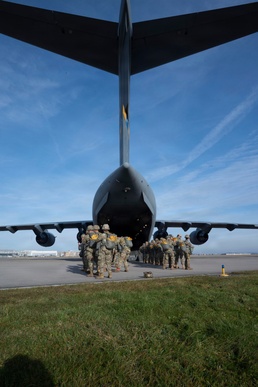
Two weeks before Christmas, most Americans are finalizing wish lists. For Air Force Reservists from Joint Base Charleston, South Carolina, the list looked different: airdrop currency, no-notice check rides, multinational integration and oceanic sortie experience. By the time they departed Stuttgart, every box was checked.
Airmen from the 317th and 300th Airlift Squadrons completed an overseas contingency training exercise alongside joint mission partners from the U.S. Army’s 1st Battalion, 10th Special Forces Group (Airborne) and the 173rd Airborne Brigade. The training placed Reserve C-17 aircraft crews into complex, unfamiliar operating environments designed to sharpen lethality and readiness, directly aligning with the secretary of war’s emphasis on more realistic, combat-focused training.
The exercise provided an opportunity for many traditional Air Force Reservists to execute missions far from their comfort zones, operating on foreign soil with allied and joint partners under compressed timelines.
“This is exactly the kind of training we don’t normally get at home,” said Maj. Taque Patino, 315th Operations Group chief of standardization and evaluations and lead planner for the exercise. “This particular exercise partner offers HALO (high altitude, low opening), HAHO (high altitude, high opening) at various altitudes, static-line training with a very experienced user, and a lot of different drop zones that are not in our own backyard, which is always fun and challenging to plan.”
Planning for the exercise began months in advance, well before most Reservists knew they would be trading holiday decorations for chilly German airfields.
According to Patino, coordination started about a year ago and was solidified around July or August to account for Reserve training hours, potential funding constraints and operational area planning. “We start super early to make sure everything is done well ahead of time and we get our objectives and everything we want out of the training exercise,” he said.
The payoff was significant. Crews conducted overseas sorties, executed personnel airdrops into unfamiliar drop zones and completed rare no-notice check rides - evaluations that are difficult to schedule stateside.
“Very rarely do we get to evaluate no-notice checks,” Patino explained. “This was a chance for us to knock out a lot of great currency items for aircrews and establish relationships we can leverage for more training throughout the coming year.”
For aircraft loadmasters, the training was particularly valuable. Senior Master Sgt. Logan Cathcart, chief loadmaster for the 317th Airlift Squadron and a native of Conyers, Georgia, described the training as a full-spectrum exercise rather than a routine trip.
“Our currency is the airdrop portion - an add-on that is not always attainable every time we go up in the air to train,” Cathcart said. “This was also a joint force exercise, not just the Air Force and the U.S. Army, but working with the German Army as well.”
Operating outside the controlled environments common in stateside training forced Airmen to adapt.
“You get different drop profiles, different terrain, different constraints and even language considerations, all of which force you to be more focused on your brief,” said Master Sgt. Cameron McMillin, a C-17 loadmaster and element leader. “It strains our ability to operate inside our norms, and that’s exactly what we need.”
That strain is intentional. Airdrop-qualified loadmasters carry additional currency requirements on top of standard flying duties - requirements that are difficult to maintain amid aircraft availability, maintenance schedules and civilian careers.
“The more we can stack into these trips where we’re hitting more objectives at once, the better it is,” McMillin said. “We want more condensed training so we’re staying current, staying green.”
As traditional Reservists, many Airmen returned home to civilian jobs immediately after the exercise. Cathcart is an airline pilot, and McMillin works as a business systems analyst. Yet for two weeks in December, they focused entirely on operational combat readiness.
“Being in this environment kind of makes you stand up a little straighter,” McMillin said. “You’re stepping on foreign soil with Allied nation partners, representing the United States, and you’ve got to have your knowledge dialed in.”
By the time the exercise concluded, the Christmas list was complete - qualifications earned, partnerships strengthened and lethality enhanced. For these Charleston-based Air Force Reservists, readiness doesn’t pause for the holidays. It gets wrapped up early.
To learn more about the Air Force Reserve and the careers highlighted in this story, visit the https://www.airforce.com/how-to-join/join-the-air-force-reserve or connect with a recruiter by downloading the https://www.airforce.com/aim-high-app on your preferred mobile platform.