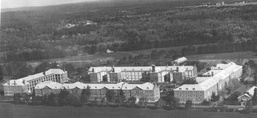
On Dec. 19, 1957, the U.S. Army Security Agency (ASA) Training Center at Fort Devens, Massachusetts, was renamed the ASA Training Center and School (ASATC&S). The change reflected the school’s modernization efforts regarding cryptologic assets, communications security, and electronic intelligence (ELINT) training and doctrine.
Army cryptologic training began as a small activity of the U.S. Army Signal Corps at Fort Monmouth, New Jersey, prior to the American entry into World War II. As the war progressed, training expanded to include thousands of soldiers to meet the increased demand for cryptologic specialists. Training soon moved to the Army’s Cryptological School at the Signal Security Agency’s (SSA) Vint Hill Farms Station in Virginia.
In September 1945, the SSA separated from the Signal Corps and became the Army Security Agency, responsible for commanding the Army’s signal intelligence (SIGINT) and communications security organizations and personnel. Vint Hill Farms Station transferred to ASA control in November, and with it came responsibility for cryptologic training. The Cryptological School was renamed the ASA School, and in 1948, officer, enlisted, and nonresident instruction at Vint Hill Farms and Arlington Hall Station, Virginia, was consolidated and moved to Carlisle Barracks, Pennsylvania.
In 1951, the ASA School moved to larger facilities at Fort Devens. Formally renamed the ASA Training Center, it continued to offer both officer and enlisted training opportunities. Officers enrolled in one of three courses depending on their specialty: radio intelligence, communications analysis, or communications security and security officer, cryptographic. Enlisted personnel took courses in analysis, Morse and non-Morse intercept, and crypto-equipment maintenance. As part of their training, all students at Fort Devens received a two-week course in direction finding. In 1955, the center also assumed the mission of training ELINT and electronic warfare (EW) specialists.
The initial structure of the ASA Training Center was a remnant of the hastily-developed Army school system of World War II, wherein staff and faculty were primarily military personnel, according to Dr. C. L. John Legere, who served variously as the school’s psychologist, education specialist and advisor, assistant deputy commandant for training systems management, and finally senior intelligence research advisor to the commandant between 1959–1991. Not until the post-Korean War military downsizing and “the resultant institutionalization” of Army, Air Force, Navy, National Security Agency, and Central Intelligence Agency cryptologic elements did the faculty expand to include several civilian specialists in areas such as “education, training, curriculum, psychology, psychometrics, teacher education,” and related fields. This process helped transform the training center into a modernized schoolhouse.
On Dec. 19, 1957, the center, housing more than 1,300 military and civilian permanent personnel and 115 officers and 1,680 enlisted students, was renamed the ASATC&S. It remained responsible for supervising and directing the training of thousands of assigned personnel, students, and non-residents; preparing and revising ASA publications; research and development of academic and technical fields; and hosting training conferences. In its annual report for 1957–1958, the school reported a reduced number of trainees at the school due to a decline in enlistment within the ASA, the Morse interceptor specialty being the most directly impacted.
Two decades later, the ASATC&S was redesignated the U.S. Army Intelligence School Devens (USAISD) and made subordinate to the U.S. Army Intelligence Center and School (USAICS) at Fort Huachuca, Arizona. Fort Devens continued to provide officer and enlisted training in SIGINT-related fields until that, too, transferred to Fort Huachuca in the mid-1980s. For the last few years of operations, USAISD focused on EW/cryptologic and manual Morse training for all Department of Defense personnel. In 1988, the Base Realignment and Closure (BRAC) Committee recommended consolidation of all intelligence training at USAICS, officially closing the Devens school in 1994.
Article by Erin E. Thompson, USAICoE Staff Historian. New issues of This Week in MI History are published each week. To report story errors, ask questions, request previous articles, or be added to our distribution list, please contact: TR-ICoE-Command-Historian@army.mil.