MARINE CORPS BASE CAMP PENDLETON, Calif. — The Marine Corps Warfighting Laboratory (MCWL) is shaping the future of force modernization at Exercise Steel Knight 25 (SK25), a large-scale annual training event that brings together I Marine Expeditionary Force and units across the Fleet Marine Force in a whole of Marine Air Ground Task Force event.
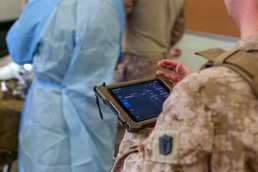
MCWL is using SK25 as a living laboratory—evaluating new technologies, refining innovative medical support concepts, and synchronizing experimental design with the exercise’s training objectives. The goal is to ensure the data gathered is credible, analytically sound, and valuable for shaping future doctrine, training, and capabilities.
“Steel Knight gives us the opportunity to put emerging ideas in front of Marines in a realistic operational environment,” said Navy Cmdr. Kellye A. Donovan, branch head of Expeditionary Medicine, Marine Corps Warfighting Laboratory. “We are learning in real time what works, what needs refinement, and how we can best support a force that must remain agile, lethal, and resilient.”
This year’s experimentation emphasizes expeditionary medicine and Health Service Support. MCWL is testing modular, scalable medical support capabilities designed to improve survivability and casualty care across distributed operations. Donovan said these concepts are being demonstrated and evaluated as Marines maneuver across air, land, and sea—mirroring the conditions they may face during real-world contested logistics scenarios.
Additionally, SK25 provides the opportunity for the Marine Corps to integrate with Naval medical staff and capabilities to provide prolonged casualty care and forward surgical capabilities across the Naval enterprise to ensure survivability across the continuum of care.
MCWL’s efforts aim to better understand how small, agile medical teams can sustain distributed forces, how medical networks can be more resilient, and how forward-positioned capabilities can enhance combat effectiveness. These insights feed directly into the Marine Corps’ broader vision of a globally integrated, interoperable medical support network.
MCWL’s experimentation during SK25 supports the Marine Corps’ commitment to the Joint Warfighting Concept 3.0, focusing on seamless integration, expanded maneuver, pulsed operations, and resilient logistics. Testing new concepts in a field environment enables the Marine Corps to validate capabilities faster and more effectively, ensuring Marines can operate with increased agility and decision-making speed across multiple domains.
Lt. Col. David Alger, Concept Development Team One lead, Experiment Division, Marine Corps Warfighting Laboratory, explained. “As an essential part of experimentation goals MCWL is also working alongside joint forces, allies, and partners, reinforcing the Marine Corps’ commitment to cooperation and interoperability.”
“Shared training environments allow U.S. forces to refine warfighting concepts, enhance forward sustainment mechanisms, and ensure the joint force remains the preeminent military power capable of honoring security commitments abroad,” said Alger.
The data and insights collected during Steel Knight 25 will be analyzed and used to inform future Naval capability development. MCWL’s work ensures that modernization efforts remain grounded in rigorous experimentation and real-world feedback from Marines on the ground.
“Every lesson we learn here strengthens the force,” Donovan said. “Steel Knight is one step toward building a more integrated, sustainable, and future-ready Marine Corps.”
Both Donovan and Alger emphasized that throughout the experimentation cycle MCWL remains focused on learning, adapting, and advancing the technologies and concepts that will prepare Marines for the conflicts of tomorrow.