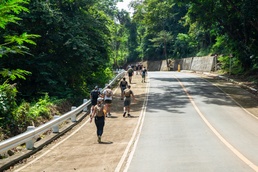
TARLAC, Philippines – The humid air hung thick and heavy as the trail wound upwards, each step a battle against the relentless incline. Sweat plastered clothes to the backs of U.S. Marines and Sailors as they pushed onward for seven kilometers alongside Philippine Marines toward a hilltop goal seemingly beyond each the next rise. Reaching the summit, they found not only a panoramic vista, but also the unexpected -- a lone figure, clad in a khaki battle uniform that seemed ripped from the pages of history. As the Marines of both nations reached the top, he welcomed them to the sacred site.
It was a carefully arranged encounter, a gesture of partnership atop Mount Samat to visit the Shrine of Valor. The Marines and Sailors assigned to Marine Rotational Force-Southeast Asia were participating in Exercise Marine Air Support Activity 2025 and were about to receive a history lesson unlike any other. Led by Rizaldy D. Mamuad, their history guide invited by their Philippine Marine Corps counterparts, would transport them back to the Battle of the Pockets, part of the Battle of Bataan, walking them through the memorial's seven sites and revealing the bond forged in shared sacrifice between the United States and the Philippines during World War II.
“Conducting this hike and memorial visit allowed the Marines and Sailors of MRF-SEA to learn about our history in the Philippines, the Battle of Bataan and the legacy of the armed forces in World War II,” said U.S. Marine Corps Maj. Steve Lundin, logistics officer, MRF-SEA, who helped organize the professional military education and the hike event. In a classroom session ahead of the hike, the group learned about the three months of conflict against Japanese military forces in the jungles of Luzon, and where over 72,000 U.S. and Philippine service members were captured as prisoners of war and began what is now known as the Bataan Death March on April 10, 1942. The already malnourished prisoners – mentally and physically exhausted from combat – endured grueling and seemingly unending days of walking in the tropical heat under the harsh treatment of their captors. Over the course of six days, prisoners were forced to march over 65 miles to San Fernando, where they were forced into crammed boxcars to Camp O’Donnell – leaving no room to breathe or move in the sweltering cars, causing more men to die due to exhaustion and suffocation during transport. By the end of the Bataan Death March, an estimated 5,000 to 18,000 additional U.S. and Philippine troops died. “Hiking this small portion of the Bataan Death March was more than a challenge,” said U.S. Marine Corps Sgt. Chardonnay Schwartz, the ammunition chief of MRF-SEA and a participant of the hike and tour. “It was an honor and tribute the warriors who endured it, to remember their sacrifice, resilience, and to embody their unbreakable spirit.”
From suffering and fighting side by side in 1942 to now revisiting the same battlegrounds almost a century later, the Philippine-U.S. partnership is still as strong as ever. From fighting side by side in 1942 to revisiting the ground together nearly a century later, the U.S.–Philippines alliance endures. During MASA 25, participants strengthened interoperability through training while building personal connections through events like the Mount Samat hike that highlight the bond between the U.S. Marine Corps and the Philippine Marine Corps. Marine Air Support Activity 2025, is an annual joint Philippine and U.S. military exercise focused on mutual defense, strengthening relationships, and rehearsing emerging aviation concepts, held Oct. 13-24. MRF-SEA is a flexible task force that varies in size, capability, and composition, to accomplish different types of missions, led by the command element of the 15th Marine Expeditionary Unit. Much like the Unit Deployment Program or MEU deployments that leverage purpose-built units, MRF-SEA maintains a forward presence and enhances Marine Corps crisis and contingency response capabilities. MRF-SEA is uniquely organized to support security cooperation and advance mutual security objectives shared with Southeast Asian Allies and partners.