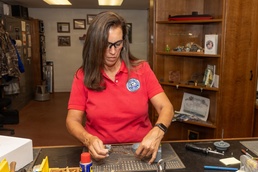
If the film The Italian Job (2003) made safe cracking look flashy, Norfolk Naval Shipyard’s (NNSY) Woodcraft Shop (Shop 64) makes it look mission ready. Inside the shipyard, smell of cut brass and oil hangs in the air. Benches are tight with tools, tags, and small parts. Every drawer has a purpose, and every key has a story.
NNSY locksmiths Susan Epperson and Jerry Manning, seated in the Woodcraft Shop, guard the flow of keys, safes, and secured spaces across ships, submarines, and shore. Their scope is wide and steady. As Locksmith Shop Lead Mechanic Susan Epperson puts it, “We do everything. We help people out of a lot of jams, getting them out of any lock situation. We can open anything, mostly by picking or whatever is feasible.”
Their work keeps watch sections moving, keeps classified material protected, and keeps crews on task. It supports the shipyard mission to return ships and submarines to the fleet on time and under budget. No drama, just skill and speed when it counts.
The pace is steady and high. “We service about 300 safes, we make 2,000 keys a year, approximately 100 times a year we help shipyard employees and Sailors get their keys out of their locked vehicle, about 100 jobs pertaining to people who got locked out of their office or their desk each year, among other things,” said Epperson. That volume keeps waterfront jobs on time. It also keeps controlled spaces tight when crews shift, deploy, or swap compartments.
“We are woodcrafters that do locksmithing,” said Epperson. “Locksmiths under the Woodcraft Shop, so we keep our woodcraft qualifications current as well as our locksmithing qualifications.”
After some hands-on training is conducted, the locksmiths go to a two-week lockmasters course in Kentucky. The training covers federal safe systems and approved procedures. It adheres to the rules used across Navy and Department of War (DoW) work. Students learn to open, repair, and document without harming the container or record trail.
Graduates go on a controlled list. Only those names can open and service federal containers. “We work on government-only locks. We guard our certification,” said Epperson. “That rule protects material and protects us locksmiths as well.”
Think of Charlize Theron’s character Stella from The Italian Job: calm hands, steady breath, and a safe that needs to open now. That is Shop 64 on a long day when gears grind and time gets loud.
“Major challenges are some of these safes we have to work with that are stubborn or a type of safe we never worked on before,” said Epperson. “We bounce ideas off of each other because we’re not taught any of this in school.”
The locksmiths received a call from a shipyard department after a safe built in 1930 accidentally became locked and personnel were unable to open it. “Old gear asks for patience, not heat,” said Epperson.
Safes and locks fail when they have reached their end of life date, a mechanism broke or other reasons. But at the end of the day... it doesn't matter. It's any time, anywhere. That is not a slogan, it is a plan. A stuck safe at 4:30 p.m. can stall a job, delay a turnover, or hold up a watch bill. The team keeps a jump kit ready and phones on.
Epperson says with a grin that they help people, and “we put our capes on.” Manning added, “Just waking up knowing that as simple as getting somebody in their car... that's what gets me up in the morning. That feeling comes from serving sailors and coworkers, not [making] headlines. The win is a clean click, a signed log, and a team that can finish a task.”
When a driver locks keys in a car on base, the response is joint and steady. Epperson puts it plain: “We work hand in hand with Naval Support Activity--Portsmouth’s police. They handle the scene and identification confirmation, we handle the door.”
Manning added, “That rhythm keeps stress low and damage near zero. The goal is always the same, get the Sailor back to work or home without a hitch.”
Support reaches beyond the piers. Shop 64 backs Fleet Maintenance Submarines (FMB) located at Naval Station Norfolk, Norfolk, Virginia, to support the submarine fleet. It doesn’t matter what time a calls come in.
Manning adds, “If a squadron calls, we go. That can mean a pier at dawn, a hangar late at night, or a secure site downrange.”
It circles back to that “cool heist energy,” only pointed in the right direction. Think Stella’s steady hands, not the chase. The clicks here cut delays, hold the schedule, and set up the next scene to play on time. For America’s Shipyard, the locksmiths do their part in returning the ships and submarines back to the active fleet to support the Navy’s mission. It might not be an Italian Job, but it’s a job that holds the key to helping keep the United States safe.