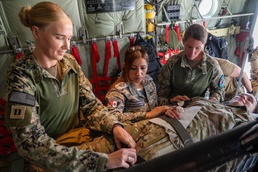
NAVAL SUPPORT ACTIVITY BAHRAIN (Dec. 4, 2025) -- Deployed from Naval Medical Center San Diego, the first U.S. Central Command (CENTCOM) independent En Route Care System (ERCS) team finished their deployment with Naval Amphibious Task Force 51/5th Marine Expeditionary Brigade (TF 51/5), recently.
Serving from April 20 to Oct. 20, 2025, both U.S. Navy Lt. Stephanie Ryan and U.S. Navy Lt. Chelsea Clark distinguished themselves through their commitment to the health and readiness of forward-deployed forces at Naval Support Activity Bahrain and across the CENTCOM area of responsibility.
ERCS focuses on providing critical medical care to service members on the way to a medical facility; the type of care that could make a difference to a patient’s survival. ERCS nurses are trained for any type of casualty evacuation (CASEVAC), be it air, land or sea.
“ERCS serves as a link between different levels of care on a patient’s journey home,” said Clark, a native of Buffalo City, Wisconsin. “We provide more definitive and critical care while in transport, be that ground, air or surface platforms.”
ERCS nurses are required to have specialized experience in either the intensive care unit or emergency department. Traditionally, a team consists of one critical care trained nurse and one corpsman, preferably a search and medical rescue medical technician (SMT). However, there’s currently a limited number of trained SMTs Navy-wide.
“We were the only two qualified personnel at Naval Medical Center San Diego when U.S. Central Command called,” said Ryan, a native of Atlanta. “So we went! We were the only options at the time.”
Additionally, ERCS personnel complete similar training to Naval aircrews, including the Modular Egress Training Simulator trainer, better known as the infamous “Helo Dunker.” ERCS are also some of the few Navy medical personnel allowed to wear Navy flight suits as working uniforms.
“We train with Army and Air Force flight teams, but we’re not ‘flight nurses’ per se,” said Ryan. “We’re not on flight orders because our focus is also for land and amphibious operations.”
ERCS nurses must complete the Joint En Route Care Course with ERCS nurses from different military branches at Ft. Rucker, Alabama. From there, they complete a 10-day operational readiness exercise to certify as deployable.
Upon arrival to Bahrain, Clark and Ryan linked up with Helicopter Sea Combat Squadron (HSC) 23, which deploys on 6-month rotations to Bahrain from Norfolk, Virginia. HSC-23 employs MH-60S Seahawk helicopters, the platforms on which the ERCS nurses trained for MEDEVAC drills.
“We took a dummy and other medical equipment and ran through scenarios,” said Ryan. “IV practice, assessment, tactical combat casualty care (TCCC), medical interventions, medical management of a patient in-flight.”
When flights weren’t available, Ryan and Clark were able to train in the baseball field with HSC-23’s junior emergency medical team or conduct pool workouts with the rescue swimmers.
“We’ve had a number of different experiences on ships, forward operating bases and multiple air platforms,” said Clark. “Fortunately, nobody has needed our actual services, but we provided critical trauma response training to members of the Army, Air Force, Marine Corps and Navy.”
During their deployment, Ryan and Clark also embarked aboard the Nimitz-class aircraft carrier USS Nimitz (CVN 68). Both lieutenants integrated with the ship’s medical department and completed damage control certifications while assuming a leadership role in advancing medical readiness among the crew.
“There aren’t many opportunities for nurses on aircraft carriers, so it was an awesome experience,” said Clark. “Their medical department was eager to learn about ERCS as much as we were interest in what carrier life was like.”
U.S. aircraft carriers only possess a single position for a “Ship’s Nurse,” usually filled by a commissioned O-3 officer. Ship’s nurses provide more generalized medical care while also leading training for hospital corpsmen. They report to a senior medical officer, typically an O-6 Naval flight surgeon, who has ultimate authority regarding all medical personnel onboard.
Though aircraft carriers have many facilities to support the medical needs of their approximately 5,500 personnel, they may not be large enough for drastic circumstances. Depending on location to the nearest medical facility and aircraft available, carrier medical personnel may need to rely on fixed winged aircraft such as the MV-22B Osprey or C-2A Greyhound for CASEVAC’s. Helicopters like the MH-60S Seahawk, can be used closer to shore.
“There’s so many differences between fixed-wing aircraft versus helicopters,” said Ryan. “Space is the major difference, but even something as simple as the type of injury can change positioning because of the type of flight capabilities.”
Fixed-wing aircraft can also provide breathable oxygen in system, but to the loud aircraft engines, certain equipment produces flashing lights to alert nurses in lieu of blaring alarms. Something as simple as the availability of power outlets on a C-2A Greyhound can make a life-or-death difference.
The nurses’ impact extended beyond U.S. Navy forces throughout their deployment. During Exercise Bright Star 25 in Egypt, Ryan and Clark served as ambassadors of U.S. medical capabilities, integrating with the U.S. Air Force, and providing more than 50 hours of ERCS training to Egyptian and partner forces medical personnel, to enhance interoperability.
“Working with the Air Force Critical Care Air Transport Team and aeromedical evacuation was awesome,” said Clark. “We learned how they set up for prolonged transfers in the C-130 [Hercules aircraft] while testing how Navy ERCS could operate in a similar fixed-wing environment.”
By the end of their deployment, both nurses achieved their Fleet Marine Force (FMF) warfare insignia. The warfare pin is available to Navy officers assigned to the Fleet Marine Force of the U.S. Marine Corps, and requires passing a written test, Marine physical fitness test, pistol qualification and finally an oral board, conducted by FMF-qualified officers.
“By earning the FMF pin during their deployment in Bahrain, Lt. Ryan and Lt. Clark proudly joined the ranks of FMF warriors,” said Lt. Cmdr. Mariya George, TF 51/5 MEB’s Surgeon and Medical Director. "This worthy and notable accomplishment is a testament to their dedication and excellence."
Both Ryan and Clark have returned home to San Diego to begin the next step in their Navy careers and new nurses will deploy in their stead. The new duo is eager to prove themselves and rise to the expectations set by Ryan and Clark.
Naval Amphibious Task Force 51/5th Marine Expeditionary Brigade is a joint task force-capable headquarters that responds to crises and contingencies; coordinates, plans and executes operations; conducts theater security cooperation; and advances emerging Naval concepts at sea, from the sea and ashore, in support of CENTCOM, U.S. 5th Fleet and Marine Forces Central Command theater objectives.