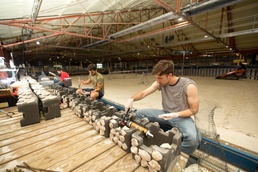
VICKSBURG, Miss. - This summer, the U.S. Army Engineer Research and Development Center (ERDC) hosted the U.S. Coastal Research Program’s (USCRP) Sediment Transport Collaborative Laboratory Experiment, or SEDCOLAB, to improve understanding of sediment transport processes by leveraging and coordinating scientific investigations from multiple research teams in a controlled, laboratory environment.
USCRP is a national coastal effort to coordinate federal activities, strengthen academic programs and address coastal community needs. The objectives of the SEDCOLAB research campaign include understanding fundamental processes of sediment transport, improving numerical modeling of sediment transport and improving instrumentation and advances in experimental techniques. In addition to advancing scientific knowledge, SEDCOLAB aims to foster collaboration among coastal researchers and communities, improving communication and helping translate scientific findings into practical applications.
Sixteen researchers and 22 students from 11 academic institutions across the U.S. traveled to ERDC’s Coastal and Hydraulics Laboratory (CHL) to study how sediment moves and how beaches change in response to waves and currents under the controlled conditions of laboratory basins and flumes. By conducting small-scale experiments in a laboratory, scientists can simulate specific wave and current patterns to better understand coastal dynamics. This research will potentially improve numerical models used to predict coastal changes and can serve as a guide for larger field studies.
“Improving our understanding of sediment transport processes is essential for delivering effective and resilient solutions to complex coastal challenges,” said Leigh Langley, a research coastal engineer with ERDC-CHL. “SEDCOLAB offered a unique and powerful opportunity to leverage CHL’s cutting-edge facilities and expertise, alongside leading academic researchers, truly creating a force-multiplier in advancing sediment transport research and closing critical knowledge gaps in this field.”
The interdisciplinary collaborative USCRP-funded projects explored wave-induced changes on beaches, sediment transport in the nearshore environment and how oyster reef breakwaters affect beach changes.
Researchers from the University of North Carolina Wilmington, University of Delaware and University of Texas studied how breaking waves affect the inner surf and swash zones. Using two wave flumes, they measured factors like pore pressure, sediment movement and changes to the beach’s shape. The findings will help improve models that assist coastal managers and decision makers before, during and after storm events.
A team from the University of Washington, Oregon State University and Stanford University investigated how waves move sand along the shoreline. By combining laboratory results with numerical modeling, the team aims to provide coastal managers with better predictions on how beaches evolve over time.
Another group from the University of Florida, University of Maryland and University of Illinois Urbana-Champaign examined how oyster shell reefs impact sediment transport and beach changes. Using CHL’s large-scale sediment transport facility, the team tested how these reefs perform under different tidal and wave conditions. The data will help create models to design reefs that maximize protection for coastal areas.
“By collaborating and leveraging research efforts that cross disciplinary boundaries and coordinating resources and personnel from different groups to collect and analyze data from projects all working on sediment transport in the laboratory setting, we can more radically advance our understanding of sediment transport processes and extend our research dollars,” said Jessamin Straub, a research oceanographer with CHL and USCRP program manager.
During these collaborations, students gain valuable hands-on experience, learning skills like using scientific instruments, designing experiments and analyzing data. Many of these students — as well as future students — will apply these data and research findings towards their advanced degrees, which will benefit the greater coastal community. The research outcomes will improve tools that coastal managers can use to better understand sediment transport and beach changes.
As part of SEDCOLAB, CHL also hosted a student training and professional development week in 2024. The goal of that event was to increase participation and exposure of coastal students to laboratory experiments and techniques and provide all participants with professional development opportunities and ideas for potential future career paths
“My time at ERDC-CHL will help in both the design and implementation phase of future lab work,” said Jacopo Composta, a student researcher and doctoral student at the University of Florida. “Specifically, seeing firsthand how the wave basin and piston work were invaluable experiences.”
“The CHL facilities are among the most unique in the world with exceptional, experienced subject matter experts who know how to run large, complex experiments like SEDCOLAB,” said Straub. “The SEDCOLAB team’s dedication to collaborative research, meticulous planning and flawless execution has allowed for significant advancement of our understanding of sediment transport processes, directly supporting the U.S. Army Corps of Engineers mission to deliver reliable and sustainable coastal infrastructure.”
For the most up-to-date information on SEDCOLAB, please visit [https://uscoastalresearch.org/sedcolab](https://uscoastalresearch.org/sedcolab).