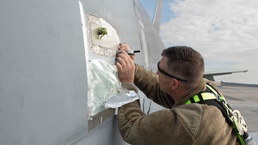
SEYMOUR JOHNSON AIR FORCE BASE, N.C. — Most people have heard of Murphy’s Law: what can go wrong will go wrong. What’s less known is that the phrase traces back to Capt. Edward Murphy, an Air Force engineer in the late 1940s, who used it during rocket-sled safety testing. Murphy and his famous precautionary tale came up recently during a discussion at the 916th Air Refueling Wing, where Senior Master Sgt. Joshua Cash, the Production Superintendent for the 916th Aircraft Maintenance Squadron, spoke about preventing accidents on the flight line. He used Murphy’s Law as a reminder that even small lapses can turn into major incidents. “It doesn’t have to be complicated, but it is about life and limb”, said Cash. “Know where you should be, stay aware, and respect the hazards.” Airmen must enter the flightline through designated entry control points and either have the proper line badge or be escorted by someone with the appropriate authority. Cash emphasized that anyone unfamiliar with flightline operations and procedures should be accompanied by someone who is, even if they already possess a line badge. He noted that flightline procedures were not created arbitrarily but were built from real-world experience. “They exist because someone, somewhere, learned the hard way,” Cash said. “From jet blast and intake zones to equipment placement and vehicle operations, nearly every standard on the flightline is tied to a real-world accident.” Those lessons shape the foundational rules Airmen follow daily. Maintaining proper distance around aircraft is one of the most important expectations on the flightline—25 feet in front of an aircraft and up to 200 feet behind it when engines are operating. Personnel should avoid cutting across active taxi routes, never step between the marshal and the aircraft, and stay clear of the red marked danger zones on the air frame. Even with proper access, anyone unfamiliar with the area or its procedures is expected to stay with an escort and use the designated movement path to avoid restricted or hazardous portions of the ramp. -30-