This year’s test mission at U.S. Army Yuma Proving Ground (YPG) is having real-world impact today-- and will influence transformation and Army doctrine for years to come.
The U.S. Army wants to reduce sensor to shooter timelines, react to threats faster, and combine all of the systems and effects available at their disposal to be ready to defend against near-peer symmetric warfare.
In addition to its rigorous testing of the Army’s most cutting-edge systems, the proving ground has made enormous gains in test methodologies for the future. Data has always been YPG’s chief product for the Army, and in conjunction with the Army Test and Evaluation Command (ATEC) the post has been developing the local architecture and data governance procedures in advance of more practical case uses for artificial intelligence (AI) in support of the test mission.
“Yuma’s been in a position where we have a pretty broad mission area because we are testing in extreme natural environments,” said Ross Gwynn, YPG Technical Director. “All the processes that take an extensive amount of time on the front end to get a test set up or to get data cleaned after collection are being optimized. By doing so, we are thinking about the system under test and analyzing the data a little more as opposed to repetitive tasks taking the majority of an analyst’s time.”
From vision-based AI learning to automating Kineto Tracking Mount-calibration processes, the proving ground is already reaping dividends from the most recent technology. More benefits are expected as the impact of the efficiency gains continues.
“It is a morale builder,” said Gwynn. “People get excited when you are doing something different and making a difference.”
Though it has been testing drones since the 1950s, YPG has become critically important to testing defeat technologies as unmanned aircraft have gained prominence. The U.S. military has used unmanned aircraft for decades to perform dangerous reconnaissance and attack missions that save lives, and the importance of small, unmanned aircraft systems (sUAS) grows with each passing year.
“Counter-UAS efforts are so important now due to the proliferation of drones in the battle space,” said Col. John Nelson, YPG Commander. “The Army is the lead agency for counter-UAS development and in the Army test community YPG is the center of excellence for testing UAS. We’re turning over solutions for the warfighter every day.”
YPG’s clear, stable air and extremely dry climate, along with vast institutional UAS testing knowledge, makes it an attractive location for testers, as does the ability to control a large swath of the radio frequency spectrum.
In addition to continuing to host semi-annual Counter-UAS competitions with wide impact, individual tests have brought significant new capabilities to the warfighter. For example, the venerable MQ-9, often referred to as the Reaper when equipped with a munition, now has a potent new arrow in its quiver thanks to YPG testing: The Switchblade 600 Block, a state-of-the-art anti-armor loitering munition featuring the potent warhead employed by the renowned Javelin anti-tank missile, demonstrated its groundbreaking capabilities through a historic UAS fire test at YPG.
“While the Switchblade 600 was initially designed for air launch, it had never been deployed from an aerial platform until now,” said Sidney Mattila, test officer. “This joint test highlighted the full capabilities of the system and expands mission capabilities for our warfighters.”
The proving ground’s expertise has been widely recognized within the Army test community. Personnel from YPG supported a Launched Effects Short-Range Special User Demonstration (LE-SR SUD) at Joint Base Lewis-McChord (JBLM) in August. The event marked the first time an active-duty unit employed the technology, which is distinct from both UAS and loitering munitions, working in tandem as expendable ‘wolfpacks’ that can collaborate semi-autonomously to penetrate enemy defenses and adapt to changing battle conditions in real time. YPG conducted intense developmental testing of the technologies during the Experimental Demonstration Gateway Event (EDGE) in recent years, particularly with semi-autonomy and autonomy at long ranges, and supplied specialized targets and expertise to the event.
“We shipped the targets commercially to Joint Base Lewis-McCord, offloaded them, and emplaced them in the target locations provided by the customer,” said Carlos Molina, YPG test officer. “All of these targets were driven by requirements for these large events. They not only support local testing, but other U.S. Army requirements.”
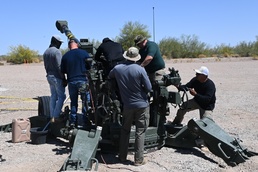
YPG has been testing improvements to the Modular Artillery Charge System (MACS) for the current generation of artillery, along with a common ignitor for both systems to minimize maintenance of the weapon. MACS consists of two types of propelling charges: The M231 is the low-zone component fired either singly or in pairs for shorter ranges, and the M232 is the high-zone component fired in multiples of three-to-five for extended ranges.
YPG’s ammunition plant has been instrumental in building multiple experimental formulations, shapes, and configurations for new propelling charges.
“There is no other facility that is a one-stop shop, from the ammunition plant that hand-assembles these items to having ready access to all of the different cannons,” said Steve Flores, YPG Long Range Precision Fires Cross Functional Team Integrator. “We have experienced weapons operators, sophisticated test instrumentation and infrastructure, a large range, and specialized gun tube inspection capabilities.”
The rugged personnel of YPG’s Arctic Regions Test Center (ARTC), the Army’s extreme cold weather test center, are recognized as world class experts of developmental test of military equipment in the natural world’s most challenging conditions. Secretary of the Army Daniel Driscoll visited the test center in April, and earlier in the year the test center’s personnel supported Operation Nanook-Nunalivut, a multi-week, multi-national science, technology, and experimentation-oriented expedition conducted by the International Cooperative Engagement Program for Polar Research and the United States Army Corps of Engineers in the furthest northern areas of Canada’s Northwest Territories. The expedition included Soldiers from the United States, Canada, and Finland, including the U.S. Army’s 11th Airborne Division. All told, the expedition covered nearly 500 miles across wintery arctic tundra and frozen sea ice, conducting operations in and between remote patrol bases.
“ARTC’s membership and involvement in ICE-PPR and the associated international security cooperation events such as this expedition ensure that the organization continues to be tied into and included in the ranks of the extremely small cadre of Arctic and Polar subject matter experts from throughout the world,” said Lt. Col. Brian Karhoff, ARTC Commander. “The Arctic experience and expertise of the ARTC personnel was an indispensable resource for the expedition.”