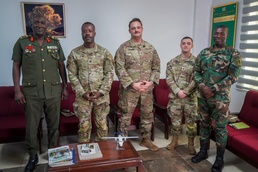
ACCRA, Ghana — When a U.S. Army civil affairs team conducted an engagement with Ghanaian Armed Forces (GAF) partners, June 8, that meeting’s purpose was to integrate U.S. civil affairs efforts with the GAF training calendar. While they made progress toward their goal, two men in that meeting learned that their paths had crossed at significant points in their lives – and for one of them, it had been a matter of life and death.
In 1989, Charles Taylor led a group of 150 men calling themselves the National Patriotic Front of Liberia into Liberia. Within a year, Taylor and his followers overthrew the regime led by then-Ghanaian President Samuel Dow and took control of most of the country.
Taylor’s organization eventually splintered, forming the Independent National Patriotic Front of Liberia, and the two began fighting each other — in addition to other groups vying for power. From 1989 to 1997, this civil war killed over 200,000 Liberians and forced over one million to flee as refugees into neighboring countries.
In nearby Ghana, William Kwabiah reported to attend the GAF’s Standard Military Course and Regular Career Course at the Ghana Military Academy in Accra in November 1993. After completing his initial training, he received his commission to become a second lieutenant in 1995.
“As a young person, I have always enjoyed helping people,” Kwabiah said. “Within the African societal context, the military offers the unique skills and competencies to deploy into areas that hitherto would have been difficult to access. I recognized that joining the armed forces would enable me to gain skills not only to assist vulnerable groups, but more importantly, to protect such people.”
In 1996, against a chaotic, historical backdrop, Raymond Jackson was born in Monrovia, Liberia’s capital. His mother was a nurse, and his father worked for the government in the Dow Administration, which provided Jackson and his seven siblings with a middle-class lifestyle.
The civil war ended in 1997 when Liberians elected Taylor president, but it would not represent a lasting peace, and this period became known as Liberia’s First Civil War. While historians generally recognize Liberia’s Second Civil War as beginning in 1999, violence in the months leading up to this next internal conflict made Jackson’s family refugees in fall 1998 after rebels killed his father in his home.
His mother took 2-year-old Jackson, his five sisters and two brothers (whose ages ranged up to 20 years old), and boarded a Ghana-bound boat near the coast of Freetown, Liberia. This boat was part of a humanitarian mission involving partners from the Economic Community of West African States such as Ghana and Nigeria, among others. The operation also included American military personnel, and their participation in that mission created an indelible memory for Jackson, even at such an early age.
“Growing up, I wanted to be a U.S. Marine because it was the Marines that came and got us,” Jackson said. “I used to think they were the coolest people on the face of the Earth.”
As a young second lieutenant, Kwabiah deployed in and around Liberia as events led up to its second civil war in the late 1990s. He served as a platoon leader tasked with refugee camp security at Essipong and later at Essiama in Ghana before heading to Liberia. Kwabiah said his primary task at the refugee camp was securing the perimeter and caring for the refugees, but his team’s mission grew to include sharing food and water, receiving refugees, allocating tentage and dealing with the unexpected scenarios that occur when desperate people are fleeing dangerous places.
“We did not plan for specific situations, like a mother giving birth at sea and being handed over to us, or a section of refugees trying to lynch someone on suspicion that he was responsible for the murder of their kinsmen,” Kwabiah said. “The journey from Liberia, as many refugees would corroborate, was indescribable. The boats were makeshift vessels not fit for their intended purposes, and some lacked food and water. The security situation was so bad [in Liberia] that the option of dying at sea was a preferred one.”
Recalling that early part of his career, Kwabiah said that he never really had time to get off duty because “refugee issues come to you around the clock,” but in that challenging mission, he experienced moments that were especially emotionally satisfying. In one case, his team received a woman who was so weak that she couldn’t eat when she got to the camp. She later went unconscious and she was eventually taken to the hospital for emergency care. According to Kwabiah, she spent about five weeks in the hospital and went from an “all hope lost” situation to making a full recovery.
“There is no greater honor than providing the basic needs of life — food, water, shelter and medicine — to vulnerable people who were sick, seasick, hungry and weak,” Kwabiah said.
After arriving in Cape Coast, Ghana, Jackson’s family briefly stayed at a refugee camp near Accra and later went on to live with an aunt in Komenda. His mother went to Accra (roughly 100 miles away) for work, and she would go back and forth to see her children in Komenda on the weekends.
In 2007, a humanitarian program to aid refugees affected by Liberia’s civil war gave an 11-year-old Jackson, his mother and two siblings the opportunity to emigrate to the United States. They ended up in Staten Island, New York, and Jackson said he “couldn’t have asked for a better path.”
Jackson was academically and athletically successful throughout middle and high school, and he went on to attend Monmouth University in New Jersey. He graduated in 2019, earning a bachelor’s in health studies with a concentration in healthcare service management. Jackson had intended to enter military service as an officer after college, but lacking the citizenship requirement at the time, he began active duty as an enlisted member.
“I wanted to go into the military because when I was little, the people who came to save my family were military, and the uniform that I vividly remember were those [U.S.] Marine uniforms,” Jackson said. “They were extremely nice and patient. My mom would talk about them every day — literally, every day — and she still does. Joining the military became something I really wanted to do as a way of giving back for what they did.”
Despite his long-held interest in becoming a reconnaissance Marine, Jackson ultimately enlisted in the Army and shipped to Fort Benning, Georgia, for basic training in October 2020, where he also attended Basic Airborne Course. He still went on to do reconnaissance work, but it would be as a cavalry scout when he reported to Fort Bragg, North Carolina, to serve in the 82nd Airborne Division.
Jackson's Army journey took him to Afghanistan, Kuwait and Poland, and as a sergeant, he later became an instructor at Fort Polk, Louisiana. Before his active-duty time ended, he returned to Fort Bragg where a first sergeant who had previously deployed with Jackson encouraged him to try civil affairs.
Jackson explored a “one-year try” opportunity by reclassifying in civil affairs and reported to the 404th Civil Affairs Battalion (Airborne), an Army Reserve unit at Joint Base McGuire-Dix-Lakehurst, New Jersey, in late 2024. Jackson said that in his new role, he enjoys being able to relate and communicate with people. In addition to English, he speaks Fante, Twi (both Ghanaian dialects), Kpelle, Grebo (both Liberian dialects), Creole and “a little French.”
“What I love most is that I’m helping everyday individuals and military people work hand in hand and side by side,” Jackson said. “You get to see things that other people won’t necessarily be able to see on a daily basis, and it allows you to use your capabilities often. It’s not every day that a Soldier can… relate to and help out individuals in a civil capacity.”
Jackson only spent about six months as a monthly drilling reservist before returning to active duty to deploy to Camp Lemonier, Djibouti, in March 2025. He has since traveled to other countries in Africa to conduct civil affairs missions, to include Ghana, where he never thought he’d return as a U.S. Soldier.
In his deployed role as a civil affairs NCO assigned to Civil Affairs Battalion, U.S. Army Southern European Task Force, Africa (SETAF-AF) Jackson coordinated and conducted engagements, maintained contact with individuals his team met with, planned missions (such as logistics and routes his team took to mission sites), prepared tactical gear and responses in case of emergencies, and drafted after-action reports, among other administrative tasks.
June 8, Jackson was on the civil affairs team that met with Kwabiah, now a GAF brigadier general and deputy chief staff officer of operations and training. Jackson, now an experienced U.S. Army staff sergeant, began this CA engagement not knowing that this particular engagement held a special surprise.
“General Kwabiah stated that in 1998, he was in charge of receiving the immigrants coming into Ghana,” Jackson said. “I mentioned that I was one of those individuals who were on the ships that came in, and he said, ‘I remember we received your family.’ At that point, I was between shock and tears.”
Kwabiah was also surprised at how their paths had crossed — indirectly, but significantly — so many years prior.
“It was a pleasant surprise, yet also a shock at the same time,” Kwabiah said. “It emphasizes the need for humans to preserve lives and support the vulnerable. I am pleased to know this, and it gives me great pleasure and satisfaction to see that those refugees are important people across the globe doing incredible things.”
While U.S. and Ghanaian representatives both enjoyed a successful interaction, the “full circle” moment changed the dynamic of this particular CA engagement.
“It made the meeting a lot more special to me,” Jackson said. “I was suddenly having a conversation with somebody who had played a significant role in my life. That broke the ice for our entire team because we all spoke more on a personal level than most people would.”
Going forward, Jackson would like to see future CA teams build on the foundation his team has developed with members of Ghana’s military to further the U.S.-Ghana relationship for mutual benefit.
“I hope the relationship we established is maintained for a very long time for the good of both countries, and that it leads to much more development throughout the country and more chances to train together,” Jackson said. “Our team on the ground has worked really hard to establish that relationship. I’m also hoping that whoever replaces us maintains that relationship and continues to get a lot of great work done with the Ghanaian military.”
Kwabiah has spent a considerable amount of time in the U.S. advancing his professional military education. He has studied at the United States Army Command and General Staff College in Fort Leavenworth, Kansas, attended the Army War College in Carlisle, Pennsylvania, and earned his doctoral degree from Walden University. In that time, his observation of America is that of a nation comprised of diverse individuals with varied perspectives, yet united by their shared core beliefs and values.
“That gives me a fair picture of what Americans stand for,” Kwabiah said. “We have worked together in partnership and conducted training in varied spheres for the mutual benefit of our countries. Looking into the future, I am positive that America will continue to show more leadership in several areas.”
Upon returning to the U.S., Jackson has planned to continue drilling with the 404th and will resume his application process to join the Ocean County prosecutor’s office in New Jersey. He also expects to visit his mom, who now works as a home health aide in New York.