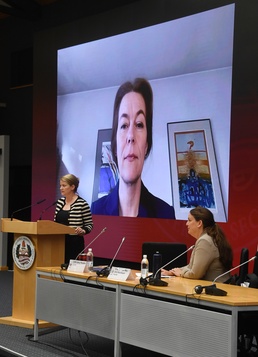
To kick-off week two of the Program on Applied Security Studies (PASS) in Garmisch-Partenkirchen on Sept. 22, 2025, participants discussed China's sub conventional warfare and how the nation uses lawfare, intimidation, and hybrid tactics short of open conflict to advance its strategic goals.
Sarah Kirchberger, Ph.D., academic director at the Institute for Security Policy at Kiel University, discussed how this plays out at sea, describing tactics from water cannon attacks on Philippine Coast Guard ships to laser dazzling and cable cutting in the South China Sea.
“These are not harmless activities – China has escalated its willingness to incur real harm, even against Western nations operating in the region,” she said.
Kirchberger was followed by Marshall Center Professor Dr. May-Britt U. Stumbaum, going a step further to explain how Beijing blurs civilian and military boundaries and expands the definition of security across society:
“Everything becomes a security issue for China, from food to science to critical infrastructure.”
The discussion, moderated by U.S. Navy Cmdr. Kathy Paradis, Marshall Center professor of transnational security studies, highlighted the complexity of responding to Beijing’s layered strategy, where nonmilitary tools create new realities and shift the balance of power without firing a shot.
Throughout PASS, participants will continue these strategic conversations to identify and understand current and future security threats. In this way, they will become better able to advise and lead in today’s complex environment.