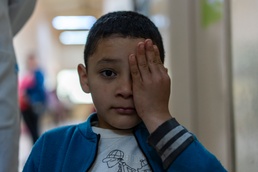
LUQUE, Paraguay — A U.S. Air Force optometry team delivered comprehensive eye care to residents of Luque, Paraguay, during Amistad 2025 — temporarily bridging a critical gap in services for a region with no licensed optometrists.
While the U.S. Airmen did not open a permanent clinic, they partnered with Paraguay’s Ministry of Health to provide the community’s first sustained access to full-scope optometric care. The mission aimed to bring urgently needed vision services to local residents while demonstrating the value of having optometry capabilities in Paraguay’s health system.
The two-week Global Health Engagement mission brought a new level of care to a country where most vision services are handled by opticians — who can fit glasses but cannot diagnose or treat eye disease — and where ophthalmologists are few and often concentrated in major cities. It marked the arrival of the area’s first licensed optometrist, a milestone for Paraguay.
“When you see someone put on glasses and watch their face light up because they can finally see clearly — that’s why we’re here,” said U.S. Air Force Senior Airman Angelica Estrada, 943rd Aerospace Medicine Squadron optometry technician. “It’s emotional. It’s life-changing.”
Amistad 2025 is a U.S. Southern Command–sponsored, U.S. Air Forces Southern–led global health engagement focused on improving interoperability, strengthening partnerships, and enhancing collective response capabilities. This year’s engagements spanned Peru, Suriname, Paraguay, Panama and El Salvador, with U.S. medical teams working alongside host-nation providers to exchange expertise, refine skills, and deliver care to communities in need.
In Paraguay, two U.S. Air Force optometrists and three technicians rotated between several clinics, treating 90–100 patients daily. They worked around the clock, seeing patients across multiple sites to meet the high demand for care. They provided comprehensive exams, prescribed glasses, and conducted preventive screenings to detect conditions such as glaucoma, cataracts, and retinal disease.
For many patients, the visit was their first-ever eye exam. One 64-year-old woman said it had been six decades since her last vision check.
“I’m very thankful because the people in this project left their families to come here to help us,” Ebonisha Gonzalez said through an interpreter. “Without you, I would have to travel very far and pay for care.”
The mission also fostered professional exchange. The Air Force team worked side-by-side with a Paraguayan ophthalmologist, introducing him to the country’s new electronic documentation system and sharing ways optometrists can help triage patients for surgical care. They also trained a local optician on basic pediatric screening techniques using minimal tools, enabling earlier detection of vision problems in children. The optometrist demonstrated how to check the way light reflects in the eyes — a quick, noninvasive test that can help identify vision issues early.
Operating with limited equipment, the team relied on manual skills such as retinoscopy to determine prescriptions — a rare necessity in modern U.S. clinics but critical in austere environments.
“This mission let me refine skills I don’t use as much at home,” said U.S. Air Force Maj. Elizabeth Moseley, optometrist. “Now I know I can still provide accurate care with minimal resources.”
The clinics also served as a readiness laboratory for the Airmen, testing their ability to adapt to changing conditions while maintaining high-quality patient care. The team frequently packed up and relocated their operations — sometimes in the middle of the workweek — simulating the rapid mobility required in deployed environments. They practiced setting up clinics in small, unfamiliar spaces, troubleshooting equipment issues on the spot, and reconfiguring patient flow without disrupting services.
Beyond the physical movement, readiness training also meant operating without their usual technology. The team sharpened core field skills like manual refraction, improvised workarounds for broken or missing gear, and coordinated logistics such as transporting sensitive optical equipment over rough terrain.
“Packing up and moving builds more than efficiency — it builds resiliency,” Moseley said. “It’s about communication, working together, and making sure everyone knows their role so that when you’re in a more stressful environment, it’s second nature.”
While their presence was temporary, the impact will last far longer — in both patient outcomes and strengthened U.S.-Paraguay ties.
“Every interaction here not only helps the community but builds goodwill,” Moseley said. “If they see Americans arriving to help in the future, they’ll remember that we came to make a difference.”
For the residents of the greater Asunción area, Amistad 2025 delivered more than clearer vision — it brought access to a level of eye care in various rural clinics they had never experienced before.