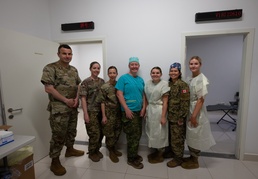
For the first time in AMISTAD’s history, a Canadian Armed Forces dental team joined U.S. Air Force providers in Suriname to deliver care and strengthen allied interoperability.
Their participation in AMISTAD 2025, led by Air Forces Southern from July 14-25, filled a critical gap after several U.S. dental providers were unable to attend.
From the Royal Canadian Dental Corps—Capt. Miko Espiritu, Capt. Amber Lipsett, Master Cpl. Emily Sampson and Sgt. Dawna Humble, worked with U.S. Air Force dental technicians at two rural locations: Brownsweg Clinic and Wanica Regional Hospital.
“This is my first time participating in a mission like this, and it’s been amazing,” said Lipsett. “I’m already planning for the next one. My favorite thing so far was getting hugged by a child patient after I extracted one of their teeth. I just about melted into the ground.”
Together, the team treated more than 300 patients, providing extractions, incision and drainage, scaling, minor oral surgeries and hygiene counseling. Their expertise brought them to Suriname, but it was their flexibility and grit that allowed them to thrive in an unfamiliar, resource-limited setting.
“We have no power tools on this mission, meaning we’re doing all services manually,” said Sampson. “That is not typical.”
The teams operated from a narrow back room of the Brownsweg Clinic, outfitted with three field chairs. Supplies were limited and with no sterilization machines or high-powered lights, every procedure relied on teamwork, shared experience and ingenuity.
“Everyone hit it off immediately with the Canadian team,” said 1st Lt. Carlos Leenen, officer in charge of operations at Brownsweg and Wanica. “This mission has given our providers a chance to share skills, and assess a large range of complaints, ailments and diagnoses in a jungle environment. It’s been amazing, and everyone’s been so positive.”
That positivity was necessary, given the challenges the team faced. Despite the challenges, personnel worked from early morning to late afternoon, adjusting to language barriers and resource constraints with help from local nurses and interpreters.
AMISTAD 2025 brought nearly 40 total force U.S. Airmen and Canadian Armed Forces members to three locations across Suriname working in partnership with the Ministry of Health.
It served as a way to exercise real-world contingency operations, where U.S. and partner nation medics could hone the skills needed to respond to global health challenges. Working shoulder to shoulder in resource-limited environments tested the agility and coordination of the combined dental team, sharpening their ability to operate under pressure and across cultural lines.
Their cumulative experience underscores one of the mission’s core objectives: preparing medics to operate in expeditionary environments. Working with limited tools, unfamiliar systems, and cross-cultural teams mirrors the very conditions Airmen may face in real-world contingencies. By integrating active-duty, reserve units, with foreign allies and partners, the mission strengthens the collective ability to respond effectively to future medical crises.
For U.S. Southern Command, engagements like AMISTAD are a visible demonstration of strategic cooperation, medical readiness and regional solidarity. A healthy population is critical to a stable and secure Western Hemisphere, and AMISTAD delivers both care and capability.
By responding together with professionalism and purpose, the U.S. and Canada reaffirmed their shared commitment to public health, security, and the enduring strength of their alliance.
“This is a model for how we should do things,” said Leenan. “We really relied on each other to get the job done by providing this community with much-needed care. One team, one mission, one chair at a time.”