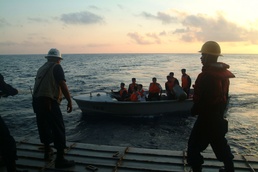
Following a port visit to Zhanjiang, China, the USS Juneau participated in a bilateral search and rescue exercise Nov. 19 off the southern Chinese coast.
Joined by the USS Fitzgerald and the Chinese vessel Zhanjiang and using air assets of the 31st Marine Expeditionary Unit and fixed-wing aircraft from the United States and China, the SAREX task force was able to find a simulated distressed vessel and send rescue and assistance teams to it.
The SAREX marked the second phase in a two-phased approach agreed upon by both countries in the Military Maritime Consultative Agreement. The first phase was a SAREX conducted off the California coast in September. Senior officers of both Zhanjiang and Juneau declared the exercise a success.
“Our collaborative search and rescue exercise has been an incredibly successful event executed by our two navies,” said Juneau’s commanding officer, Navy Capt. John D. Alexander. “Through this exercise, we have built a stronger foundation upon which to conduct future exercises and operations together. This has been an invaluable opportunity for our ships and personnel to plan and execute in tandem.”
Those from Zhanjiang were similarly pleased with the outcome.
“There were many good points to this exercise,” said Cmdr. Changping Gong, Zhanjiang executive officer, who was aboard Juneau during the exercise as a liaison officer observing the exercise from the U.S. viewpoint. “We see this as a stepping stone to future cooperation. We feel it is important to work together with the U.S. Navy to help make this region a safer place.”
The exercise began just after sunrise, when a simulated distress signal was sent to Zhanjiang from Chinese replenishment ship Dongtinghu. Zhanjiang then requested Juneau’s help, and a joint mission was put in motion.
A Chinese Y-7 Coke and a U.S. Navy P-3 Orion provided the major search capabilities while the ships steamed in formation in the search area. Once the P-3 crew detected the ship, CH-46E Sea Knight helicopter crews confirmed the sighting and kept an eye on the distressed vessel while the ships moved into position for rescue.
Using international symbols and call signs, the aerial assets were able to safely navigate the international air space and achieve the mission. Marine pilots said they felt happy to assist the process.
“Having a visual view of the distressed vessel is a key element to the search and rescue process,” said Marine Maj. Michael Kaminski, one of the CH-46E Sea Knight pilots. “For our involvement, working with the Chinese was a good learning experience, and I feel this will open the door to future training.”
After ships arrived in near the distressed vessel, each ship’s rescue and assistance team -- made up of damage controlmen, repair specialists and medical personnel -- was deployed to the vessel. Aboard the distressed vessel, the American and Chinese teams exchanged damage control training techniques and displayed their equipment.
“The (Chinese) sailors were eager to learn about our equipment and equally eager to show their capabilities to us,” said Petty Officer 1st Class Gavin C. Springstead of the Juneau rescue and assistance team.
Exercise planners said agreement on to exercise terms was crucial to success.
“It says a lot that we were able to work through cultural differences and settle on a workable plan, whose execution was both effective and educational,” said Navy Lt. Ken P. Ward, Juneau’s air boss and lead planner for the United States. “I think as U.S. sailors, we came to respect our Chinese counterparts because of their professionalism and commitment to excellence.”
All involved look forward to working with each other again, they said.
“The more we train together, the more we will understand each other,” said Alexander. “I think we are eager to not only build a better relationship, but also build skills based on the results of bilateral training.”
(Marine Corps Staff Sgt. Marc Ayalin co-wrote this article. Navy Petty Officer 3rd Class Adam R. Cole is a member of Task Force 76, and Ayalin is a member of 31st Marine Expeditionary Unit Public Affairs.)
Story by Petty Officer 3rd Class Adam R. Cole, USN, Special to American Forces Press Service