SGT RACHEL BRUNE
101ST SUSTAINMENT BDE
8 FEBRUARY 2006
Q-WEST BASE COMPLEX, Iraq " A registered dietitian conducted the second part in a semi-monthly series of individual counseling sessions and classes Feb. 8 and 9 here.
Maj. Polly R. Graham, 3rd Corps Support Command, offered advice and information to help Soldiers on post lose or successfully maintain weight.
Most of the Soldiers attending the individual counseling sessions were there for an initial evaluation as the first step of the Army Weight Control Program, said Capt. A. Michelle Moore, brigade surgeon, 101st Sustainment Brigade.
"A registered dietitian [must] give the initial counseling," said Moore, a Seffner, Fla., native. This requirement is in accordance with Army Regulation 600-9, which governs the Weight Control Program.
In addition to weight management issues, the sessions were open to Soldiers who wish to manage high cholesterol, hypertension or other special dietary needs.
"What I want [the Soldiers] to walk away with is one, two or three goals," said Graham, who is from Davenport, Ohio.
Graham began each session with a 24-hour diet recall, asking the Soldier to list everything consumed within the past day. She then asked the Soldier to describe his or her level of physical activity.
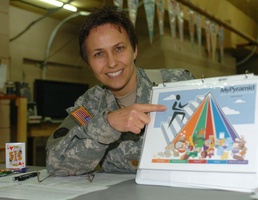
With this information, using the new United States Department of Agriculture, or USDA, food guide pyramid and caloric intake recommendations, Graham helped the Soldiers develop their goals.
The food guide pyramid, released by the USDA in 2005, is an update from the old guide Soldiers may have learned in school, which showed food groups stacked one atop the other. The new pyramid displays each food group side by side, with a figure walking up the slope of the pyramid.