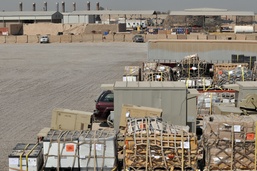
VICTORY BASE COMPLEX, Iraq– Logistical support in Iraq isn’t just limited to one operating base. Often, commodities such as fuel, equipment and water must be delivered from one area to the next. However, keeping track of those deliveries can be a challenge on its own.
Enter the Interrogator.
Although the name may evoke thoughts of policemen and rapid-fire questions, this piece of technology performs quite differently. The Interrogator helps units within the 3rd Sustainment Brigade, 103rd Sustainment Command (Expeditionary) more easily track the deliveries that enter and exit their Central Receiving and Shipping Points.
“The Interrogator is a tracking and management tool used to provide real-time data,” said Maj. Ulekeya Hill, officer in charge of the 3rd Sustainment Brigade Sustainment Automation Support Management Office, and a native of Vienna, Ga.
“Think of it as [the United Parcel Service],” explained Staff Sgt. Kerry Ferdinand, a Columbia, Md., native and the 169th Seaport Operations Company, 373rd Combat Sustainment Support Battalion, 3rd Sustainment Brigade, 103rd Sustainment Command (Expeditionary) dayshift Noncommissioned Officer in Charge of the VBC CRSP. “You have tracking numbers, you have your destinations, you have your starting destination and your end destination. From the beginning customer to the end customer, we’re tracking your cargo.”
Currently, the 3rd Sustainment Brigade, according to Hill, has more than 500 Interrogators in its area of operation. Each system is placed in the CRSP yards as well as throughout the brigade’s delivery routes to help the unit track deliveries. Once a delivery arrives at the CRSP, the Interrogator automatically records the Radio Frequency Identification Tag on each piece of cargo, confirming that the delivery has made it to the yard. The information is then sent to a database. Once the cargo leaves the CRSP for its next destination, an Interrogator at the exit gate again records the information on the tag, which confirms that the cargo has left the yard.
“It enables commanders to visually see throughput as Soldiers and units continue with the responsible reduction of forces,” explained Capt. Marcus Acklin, the 373rd CSSB communications officer and native of Lebanon, Tenn. “From a higher level, it allows the command to see how fast we’re keeping deliveries on the yard.”
The importance of the Interrogator will only grow over the next year.
“As the responsible drawdown of forces continues, it is imperative for the units to have the capability to track and manage assets in our [area of operation],” Hill said. “With the enormous amount of equipment that will be shipped either back to the states or to a different AOR, this system provides them with a viable asset to the logistics community in the way we track all commodities during this transition.”
Although the technology has proven dependable and faster for the team, Ferdinand noted that they still haven’t abandoned manual recording. In the case where a battery in the RF ID tag goes down, or the tag falls off, manual recording assists the team in ensuring that every delivery that enters the yard is entered in the database.
To mitigate the loss of batteries or other issues that may preclude accurate reporting of deliveries, Hill said it is important for units to perform maintenance on the ID tags, such as cleaning them off or changing the batteries. If the maintenance is above the unit level, field service representatives are available to help. There are also project managers located at each of the installations.
“They monitor; that’s all they do is track this system,” she said. “If the unit runs into any issues with the Interrogators, they’re here to help.”
Another aspect of RDOF will be the continual closing of bases throughout the brigade’s footprint. Once the base closes, the project manager will retrieve the Interrogators at that base, and, Hill said, it will later be determined where the equipment will go next. Until then, the Interrogator will be a valuable asset in logistical support.
“I really think this is a good system and a good way to track our assets,” Hill said, “especially when we’re doing responsible drawdown. There is so much equipment here in theater, it’s going to be key to making sure that we accurately track and keep accountability of what we have and where we have it.”