By 2nd Lt. Joseph Dennis
KHARK, Iraq – An Iraqi Soldier from 5th Tank Battalion crouched down, shielding his eyes from the sun as he examined the ground beneath a doorframe.
“Right there,” he said, motioning toward a pile of gravel. Among the rocks, a small wire rose up and led through the door, a tell-tale sign that an improvised explosive device lurked just on the other side.
“Great job!” said Spc. Benjamin Peters, a scout with C Troop, 2nd Squadron, 1st Cavalry Regiment, 4th Stryker Brigade Combat Team, 2nd Infantry Division. “What do you do now?”
Peters, a Healdsburg, Calif., native, is one of several troopers from the squadron training his Iraqi counterparts how to perform tactical site exploitation.
When terrorists detonate IEDs or fire weapons, they leave behind small pieces of evidence, usually fingerprints or pieces of hair, which U.S. and Iraqi forces can trace to individuals using modern forensics. However, oftentimes first responders are unaware of the potential evidence and tamper with it. As a result, they contaminate the site.
Staff Sgt. Travis Hoops, a mortarman from Eagle River, Alaska, also helped teach the course.
“We’re trying to demonstrate to the Iraqis how much evidence can be obtained from blast sites and crime scenes,” Hoops said. “Doing this sort of training is hard and frustrating at times, but I like the challenge.”
Using modern examples from attacks in Iraq and Afghanistan, Hoops and Peters took soldiers from the 5th Tank Battalion, 36th Brigade, 9th Iraqi Army Division, through a combination of classes and practical exercises to familiarize them with exploiting attack sites.
They stressed the importance of photographing everything at the site before moving it so investigators can view the photos later and get a clear picture of the scene.
Teaching the new information was a slow process, but it wasn’t long before the Iraqi soldiers began to catch on and apply their new skills.
During one exercise, a group of trainees entered and cleared a room containing a fake cache set up by C Troop. After apprehending an “insurgent,” they simulated carefully taking pictures of the hidden weapons.
Smiling, an Iraqi soldier lifted up a mattress to reveal a rifle and several magazines.
“Sneaky!” said the Iraqi soldier in English.
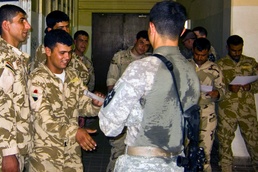
With the final exercise completed, the Iraqi soldiers gathered around Hoops to receive their completion certificates.
Hoops congratulated each of them and patted some on the back as they came forward.
“I wish we could train these guys all day,” he said at the end of the training. “They get the idea, but they need more practice.”
After the introductory class, C Troop instructors said they hope to conduct follow-up training in the future.
Tactical site exploitation is a skill the Soldiers of 2nd Sqdn., 1st Cav. Regt., said their Iraqi partners will need to master quickly as the squadron’s departure date nears. However, with C Troop’s help, the Iraqi army could soon be using its own forensic evidence to bring criminals to justice.