By Sgt. Jason A. Merrell
JOLON, Calif. - The recent Combat Support Training Exercise at Fort Hunter Liggett, June 16 - 24, was designed to prepare U.S. Army Reserve Soldiers for real-world combat environments by simulating forward operating bases in Afghanistan. But, how do you measure a Soldier’s success rate during the exercise in the absence of live ammunition and real fatalities?
SRI International, a research and development company, based in Menlo Park, Calif., responded to that question by integrating its FlexTrain technology for the first time in a full-scale Army Reserve training exercise.
FlexTrain utilizes advanced GPS technology and computer software to track and realistically recreate the battlefield in a 3-D representation with high accuracy, said Derek Artz, an instrumentation deputy with SRI Intl.
“We’ve got up to 500 Soldiers instrumented right now and then another 200 of those tracking devices are put on civilians on the battlefield, vehicles, opposing forces, and other assets on the training lane to facilitate the realism of the training scenario,” said Artz.
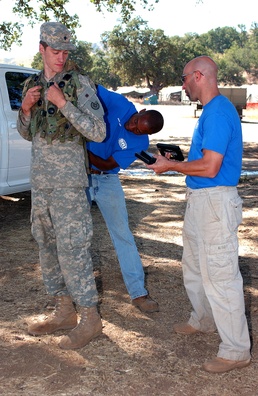
The technology starts with a device called the Enhanced Dismount Instrument, explained Artz, which is strapped to the Soldier’s back and weighs less than an interceptor body armor plate. The information from the Soldier’s Common Access Card is swiped into a database and linked into the device.
The instrument broadcasts data back to the Mobile After-Action Review Facility, where it is recorded by the tactical analysis monitoring station which translates the data into a 3-D representation of the training area. The Soldier’s location is represented by an avatar.
The data transmitted, however, is much more complex than just recording troop names and positions. The FlexTrain is also tied into the Multiple Integrated Laser Engagement System 2000 gear worn by the Soldiers and OPFOR, allowing Soldiers during the AAR to see who they shot during the training.
“Because of our tie-in with the MILES 2000 gear, we can see weapon engagements shown as a shot line. You can see enemy fire, friendly fire, or fratricides, as well. So there’s a lot of teaching points and eyebrows raise from the audience when they see it for the first time [during the AAR], and the 3-D model really brings it home,” Artz said.
For added coverage of the training, all radio communications from the training lanes are recorded and a SRI videographer stays on-site to capture the action on a handheld video recorder.
SRI employees aren’t alone. They work closely with the Observer Controller/Trainers, who are in charge of monitoring and evaluating the exercise. The combined data of the FlexTrain, along with the joint efforts of the SRI employees and OC/Ts, creates unique opportunities during the training lanes.
“They actually have OC/Ts dedicated to our live monitoring station,” said Artz. “We also provide those OC/Ts with a communications infrastructure, so that the guy sitting at the monitoring station is watching the live tracking as the convoy is moving down the lane, or as the Soldiers are doing a search of a village. The OC/T on the lane, with his eyes on the action, can radio back to the OC/T sitting at the monitoring station, have him click a button, make a time stamp and pull up that exact moment during the After-Action Review.”
After the training day was completed, the OC/Ts marked all of the significant events they found relevant and compiled it – developing key training points to present to the Soldiers during an AAR.
“The AAR is the culmination of the technology we bring to the field,” said Artz.
The technology creates a complete, digital replay of a scenario that encompasses the actions of each participant on the battlefield. Everything is recorded; everyone’s movement, shot lines, communications and kills; all synchronized with video footage from an on-site videographer and communication captured from radio chatter. This gives the AARs a level of depth that cannot be matched by traditional means, said Artz.
“I think it’s great,” said Spc. Chris Bryant, a member of the 352nd Combat Sustainment Support Battalion, based out of Macon, Ga. “I was in one of the AARs and was able to see how things played out, and I got a really good idea of where I went wrong. I learned a lot and I’ve already been able to use what I learned over the past couple days.”
“The resources being provided from this technology are giving non-commissioned officers in charge and officers a graphic visualization of what Soldiers are doing that they wouldn’t be able to experience otherwise,” said Cpt. Byron Elliott, an OC/T. “It greatly enhances the training value of the exercise.”
“I’ve never seen anything like the equipment that’s been employed in this exercise and I’ve been in the Army for almost 23 years,” said Lt. Col. Robert Wiley, commander of the, 352nd CSSB. “The high-tech, video replay capability that we’re seeing is incredible. My eyes are wide open, seeing exactly what we did at our training events, and Soldiers are learning.”
While the technology provided an eye opener for Wiley, it has served as a motivator for many of the Soldiers, according to Artz.
“Generally, at the end of a training exercise, Soldiers will say this is some of the best training they’ve ever had,” he added.
The FlexTrain system provided by SRI International, combined with pre-deployment, scenario-based training at CSTX, sets a new standard as it moves the U.S. Army Reserve further into the technological age – allowing Soldiers to enhance their readiness and gain confidence to successfully complete their mission.