A strategic attack against the United States is remote but the nation must stay vigilant and capable if it is to address the carefully planned and potentially global threats that are part of today’s evolving security environment, Navy Adm. Cecil D. Haney said today.
“Our nation is dealing with a global strategic environment that is complex and dynamic, perhaps more so than at any time in our history,” the commander of U.S. Strategic Command told members of the Air Force Association, the National Defense Industrial Association and the Reserve Officers Association.
He described advances in state and nonstate military capabilities across the domains of air, sea, land, space and cyber.
“Worldwide cyber threats are growing in scale and in sophistication. Nuclear powers are investing in long-term and wide-ranging military modernization programs. Proliferation of weapon and nuclear technologies continues,” the admiral continued.
“Weapons of mass destruction[or WMD,] capabilities and delivery technologies are maturing and becoming more readily available,” Haney added. “No region of the world is immune from potential chemical, biological, radiological or nuclear risks.”
The strategic environment, he said, is increasingly characterized by violent extremist organizations, regional unrest, protracted conflicts, budgetary stresses, competition for natural resources, and the transition and diffusion of power among global and regional actors.
Against this backdrop, Haney said, “U.S. Stratcom’s mission is to partner with other combatant commanders to deter and detect strategic attacks against the United States and our allies, and to defeat those attacks if deterrence fails by providing [President Barack Obama] options.”
The admiral said his command priorities include providing a safe, secure and effective nuclear deterrent force, partnering with other combatant commands, addressing challenges in space, building cyberspace capability and capacity, and preparing for uncertainty.
Haney said U.S. strategic nuclear capabilities are more than the nuclear Triad.
“Our strategic nuclear capabilities actually include a synthesis of dedicated sensors, assured command and control, the Triad of delivery systems, nuclear weapons and their associated infrastructure, and trained and ready people.”
The Integrated Tactical Warning and Attack Assessment, or ITW/AA, network of sensors and processing facilities gives critical early warning and allows Stratcom leadership to choose the best course of action in developing situations, he said.
The on-orbit capability is changing from the Defense Support Program, with a first satellite launch in 1970, to the Space-Based Infrared System, or SBIRS, program that Haney says is “on track to provide continued on-orbit capability.”
He added, “The survivable and endurable segments of these systems, along with the early warning radars, are being recapitalized and are vital to maintaining a credible deterrent.”
On nuclear command, control and communications, the admiral called assured and reliable NC3 critical to nuclear deterrent credibility.
Many NC3 systems need modernization, he said, to optimize current architecture and leverage new technologies so NC3 systems interoperate as the core of a broader national command-and-control system.
“We are working to shift from point-to-point hardwired systems to a networked Internet-protocol-based national C3 architecture,” he said, one that will balance survivability and endurability against a range of threats, deliver capabilities across interdependent national missions, and ultimately give the president more decision time and space.
On the nuclear Triad, Haney said the 2010 Nuclear Posture Review advised that retaining all three Triad legs will best maintain strategic stability at reasonable cost and hedge against potential technical problems. The president’s 2013 U.S. Nuclear Weapons Employment Planning guidance reinforced this view.
Haney said Stratcom executes strategic deterrence and assurance operations with intercontinental ballistic missiles, or ICBMs, ballistic missile submarines and nuclear-capable heavy bombers.
The whole of the Triad’s strategic deterrence, he said, is greater than the sum of its parts.
The ICBM force promotes deterrence and stability by fielding a responsive and resilient capability that imposes costs and denies benefits to those who would threaten U.S. security, Haney said. The Minuteman III ICBM, fielded in 1970, is sustainable through 2030 with smart modernization and other investments. The Air Force is studying a range of ICBM concepts that will shape the land-based deterrent force well beyond 2030, he added.
On ballistic missile submarines, the admiral said recapitalizing the sea-based strategic deterrent force is his top modernization priority and that he will work closely with the Navy.
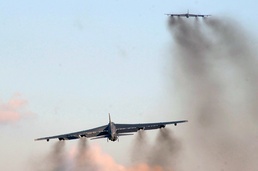
The nation relies on the long-range conventional strike capability of heavy bombers but the nuclear capability of B-52 and B-2 bombers provides flexibility, visibility and a quick hedge against technical challenges in other Triad legs, Haney said, adding that maintaining an air-delivered standoff capability is vital to meeting U.S. deterrence commitments and conducting global strike operations in anti-access area-denial environments. Planned sustainment and modernization will ensure a credible nuclear bomber capability through 2040, the admiral said.
Nuclear weapons and their supporting infrastructure underpin the Triad, he added, and all warheads are on average 30 years old.
“While surveillance activities are essential to monitoring the health of our nuclear warheads, life-extension programs are key to sustaining our nuclear arsenal, mitigating age-related effects and improving safety and security features,” Haney said.
DOD and the Department of Energy must continue to work together to keep the multidecade plan for a modern, safe, secure and effective nuclear stockpile on track, he added.
Operating the nuclear deterrence force requires skilled operators, the admiral said.
“It is the professionalism and ability of our men and women in and out of uniform that gives our military the decisive advantage. They do everything from strategic planning to mission execution and maintaining and sustaining nuclear weapons,” Haney observed.
“Earlier this month we successfully test launched two D-5 missiles, marking more than 150 successful test launches,” he added. “This success is made possible by all the highly skilled professionals that are behind our strategic capability.”
The nuclear arsenal is smaller than it has been since the late 1950s, the admiral said, but nuclear weapon systems today remain capable and will serve the United States well into their fourth decade.
The percentage of spending in recent years on nuclear forces has gradually declined to 2.5 percent of 2013 DOD spending, a number that Haney said is near historic lows.
“Our planned investments are significant but are commensurate with the magnitude of the national resource that is our strategic deterrent,” he said, adding that failing to commit to these investments risks degrading the deterrent and stabilizing effect of a strong and capable nuclear force.
Quoting Defense Secretary Chuck Hagel, Haney said, “‘ … We also have to remember that every day we help prevent war. That’s what we are about. And we do that better than anyone else.’”
(Follow Cheryl Pellerin on Twitter @PellerinAFPS)
Story by Cheryl Pellerin, American Forces Press Service