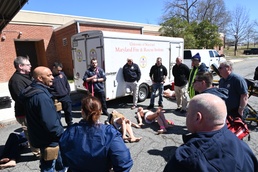
FORT GEORGE G. MEADE, Md.– Fort Meade Emergency Medical Services hosted the National Association of Emergency Medical Technicians Tactical Emergency Casualty Care training March 20-21. The training presented EMS providers with concepts, principles, and skills to deliver emergency medical care for patients in a civilian tactical environment.
The two-day specialized course drew EMS personnel from Fort Meade and the surrounding jurisdictions of Anne Arundel, Howard, and Baltimore Counties.
“The course not only reinforces crucial trauma care techniques but also ensures that local providers are equipped with the most up-to-date methods to improve patient outcomes in critical situations,” said Carrie A. Krest, Chief of Fort Meade Emergency Medical Services.
Major course topics instructed by the Maryland Fire & Rescue Institute focused on rapid trauma assessment, stabilization, and decision-making in the field that included hemorrhage control; surgical airway procedures and needle decompression; strategies for treating wounded responders in threatening environments, and techniques for dragging and carrying victims to safety. Topics ensured that attendees are prepared to deliver the best medical care possible before patients reach the hospital. Methods of instruction included lecture, discussion, hands-on skills stations and team-focused practical exercises.
“By hosting the training, Fort Meade EMS reaffirms its commitment to maintaining high standards of emergency care for both the base and the surrounding community,” Krest said.
The TECC training provides evidence-based and best practice trauma care that integrates nomenclature familiar to civilian EMS, fire, and law enforcement. The training plays a critical role in enhancing the skills necessary to providing care outside normal operating conditions of most EMS agencies, such as responding to a mass casualty or active shooter event.
“The course is a reminder of the importance of ongoing professional development in the ever-evolving field of emergency medicine,” Krest said.