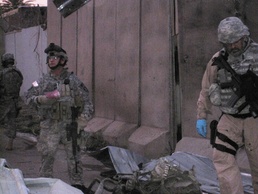
BAGHDAD, Iraq — On April 4, Soldiers of the 49th Military Police Brigade assisted and advised Iraqi police officials as they investigated multiple blast sites created from vehicle born, suicide bomb attacks against foreign embassies here. These joint investigations were initiated upon the endorsement of Iraqi police officials.
Responding to two deadly suicide vehicle bombings, which caused severe property damage, multiple deaths and dozens of injuries, Joint Investigative Teams from the 49th linked up with Baghdad police officials at the blast sites to conduct investigations that may lead to the arrest of the perpetrators of these attacks.
At each scene, American investigators worked with Iraqi police to secure the crime scene, collect and protect evidence, and interview potential witnesses who could possibly provide information that could lead to an arrest.
"The JIT assists the Iraqi on-scene commander in cordoning off the area and collecting evidence for exploitation. We advise and assist the Iraqi police on the scene to enable them to lead in the investigation," said Maj. Jeanette Stuart, an officer in charge of one of the joint investigative teams.
Although performing an investigation is the most important function of a JIT, an investigation is impossible without a secure crime scene. The crime scene must be protected from pedestrians, secondary explosive devices, and follow-up attacks. Working with the Iraqi army and Iraqi police, the security element transporting the JIT investigators to the crime scene ensure the investigators are protected from these possible threats.
"Our job is to help the investigators do their job. It is challenging because the situation is very fluid. Because we can't predict when we will get the call and where we will be sent, we always have to be ready to respond quickly and remain flexible," said 1st Lt. Bradley Churchill, the Platoon Leader of the security teams that secure JIT crime scenes and investigators.
Once the 49th was aware of the bombings on Easter Sunday, Churchill was called by the 49th staff and ordered to have his teams ready as soon as possible. While Churchill's team was alerted, Maj. Dillon Haynes, an officer in charge of a joint investigative team, called his Iraqi Police partners at Baghdad's Provincial Department of Police to offer the assistance of the 49th.
The PDOP commander, Maj. Gen. Ali, accepted the offer as soon as it was relayed to him by his Chief Investigative Officer, Lt. Col. Shakir. "When we heard there was a major bombing in Baghdad, we immediately called PDOP to see if they would like us to assist with the investigation. When Maj. Gen. Ali said, yes, and the Baghdad Operations Center approved, we linked up with our security elements and we were ready to roll," said Sgt. 1st Class Arne Eastlund. Eastlund was the senior non-commissioned officer on Haynes' investigative team.
Since the 49th began their deployment in Iraq in October 2009, Haynes and Sgt. 1st Class Eastlund have worked closely with Baghdad's PDOP on a variety of issues.
According to Eastland, this close relationship was instrumental in the PDOP quickly accepting the assistance of the 49th. "All those meetings paid off. We built a level of trust. They think we will have their best interests at heart. They trust that we will advise, not dictate," said Eastlund.
Some of the important advice and assistance shared with the Iraqi police by a JIT is given by experienced investigators from the Combined Explosive Exploitation Center .
Capt. Jonathan Ralston, the commander of a CEXC team in Baghdad was a member of Haynes' JIT on Easter Sunday. According to Ralston, the responsibility of CEXC is primarily to "collect and process all IED (improvised explosive device) related evidence from a post-blast site." Ralston believes that the JIT's combination of CEXC investigators and the Military Police and their law enforcement professionals allows the JIT to optimally exploit a crime scene for evidence.
"JIT works well because it leverages the investigative expertise of experienced law enforcement professionals with our expertise in collecting and processing post-blast site evidence," said Ralston.
"We are not experts on identifying and interviewing witnesses, and they are not experts on improvised explosive devices," added Ralston. "There is more to these crimes than just a bomb."
With the help of CEXC investigators and law enforcement professionals, the 49th is using joint investigative teams to help Iraqi police develop and strengthen advanced policing skills.
In 2005 and 2006, as in their current deployment, the 49th directed the training of the Iraqi police throughout Iraq. However, during their previous deployment, the 49th focused on assisting the Iraqi police with developing basic skills and obtaining basic resources necessary for any functioning police unit.
"In 2006, our focus was to make sure the Iraqi Police had sufficient uniforms, weapons and force protection materials; knew how to handcuff, and showed up to work and were paid on time," said Brig. Gen. Donald Currier, commander of the 49th.
"Now, we are assisting them with advanced investigations. Our partnership with the Iraqi police has come a long way," added Currier, who served as the deputy commander of the 49th in 2005 and 2006.
One important goal of further developing the Iraqi police's capacity to conduct advanced investigations is to strengthen the credibility of the Iraqi Police in the eyes of the Iraqi judiciary. According to Lt. Col. Timothy Rieger, Staff Judge Advocate and Rule of Law coordinator for the 49th, JIT can help build a closer relationship between Iraq's police officers and judges.
"The Ministry of Justice has just implemented a forensic evidence protocol that is consistent with international principles," said Rieger.
"Since JIT investigators and the Iraqi police who partner with them use these protocols as a guide, these types of investigations can help integrate the Iraqi police and Iraq's Judiciary," added Rieger.
Although the 49th and their joint investigative teams are looking forward to assisting the Iraqi police and Iraq's judiciary on the investigation of major crimes, it is not possible unless Iraqi authorities request their assistance.
Since the implementation of the Security Agreement between the United States and the sovereign nation of Iraq in the summer of 2009, Iraq's security forces lead and command all security efforts in Iraq. However, they will still accept assistance and advice from the American military.
In the case of the Chief Investigating Officer at PDOP, Lt. Col. Shakir, the assistance his police receive from the 49th is greatly appreciated.
"There is a huge success when it comes to investigations between the 49th, PDOP, and the Baghdad Operations Center. We push for these missions where we work together. The 49th has always supported us. They always do their job. They are on it!"