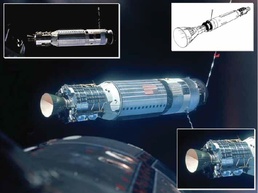
In the 1960s, the Air Force wanted to standardize all new spacecraft. This meant that the Agena D propulsion system had to be good for many missions and be implemented in four spacecraft families, requiring lots of tweaks and improvements to the XLR81 Agena engine. This necessitated validation in a test environment. B-cell, in Area 1-42 at the Rocket Propulsion Lab (a precursor to the AFRL Rocket Lab) served the purpose; testing the new engine model’s components and putting it through its paces. The experience with the XLR81-BA-9 continued to serve the lab well. As the folks at the Space Systems Division (SSD) began to study further evolutions of the engine, the AFRL Rocket Lab continued to support SSD with both testing and engine expertise. Several design improvements resulted, including the XLR81-BA-13 “Ascent Agena” or “Advanced Agena”. The Corona spy satellite using the Agena engine was the first satellite to maneuver on orbit (turning, rotating and shifting orbits).