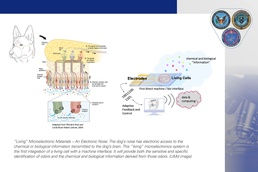
Basic research from 2014 has led to an effort to create a biological-to-electronic platform that rapidly senses information using bioengineered canine olfactory (smell) receptors and transferring it into actionable electronic forms—in other words, an “electronic nose.”
The Defense Threat Reduction Agency’s (DTRA) Chemical and Biological Technologies Department in its role as the Joint Science and Technology Office (JSTO) for Chemical and Biological Defense, an integral component of the Chemical and Biological Defense Program, invested with the University of Maryland (UMd) to envision live, “rewired” bacteria that independently survey warfighters (for example, their gastrointestinal tracts), home in on disease-causing agents, and synthesize and deliver therapeutics for effective treatment.
The initial studies focused on engineering bacteria to sense and kill pathogens, or swim to cancer cells and activate gene expression processes that alter gene information and ensuing cellular biochemistry to initiate cell death. The goal was to design and build new bacteria combining the tools of synthetic biology with biofabrication using nature’s existing ability of self-locomotion and gene expression to create bacteria programmed to stand on guard for harmful bacteria and viruses. Biofabrication extended the reach of synthetic biology by providing means for integrating biological constructs into microelectronic-fabricated systems to test their function and provide for electronic control.
The DTRA JSTO program catalyzed a new field that integrates electronics with biology and the direct transfer of information between two mediums of information flow in electronics through the electron and in biology through the molecule that typically do not intersect. The researchers found they could convey information that is rich with content, rapid, easily accessed, and bidirectional. They applied their discovery in several areas: