By Staff Sgt. Stephen Roach
PORT-AU-PRINCE, Haiti — U.S. Army divers are deployed to Haiti in support of operation unified response. The small team of engineers specializes in underwater repair, recovery operations, as well as demolition.
The 544th Engineer Dive Team from Fort Eustis, Va., was in Belize for a partner nation training opportunity with divers from Central Belize and Guatemala the day the earthquake devastated the island nation of Haiti and they were sent straight to Port au Prince, Haiti, to start mapping and surveying the Port-au-Prince Seaport shipping lanes to ensure there was access to the badly damaged pier.
There are only two ways to get supplies into Haiti, by air or by sea. The airport here has been congested since the earthquake struck and the seaport's north pier was completely destroyed. That meant the south pier which was also badly damaged has to be repaired to allow for the offload of much needed relief supplies from large vessels.
Ship-to-shore transport runs almost non-stop during the day, but the smaller vessels can only move so many supplies per trip. In order for the south pier to be used the Army divers have to restore vertical load stability.
Capt. Scott Sann, commander, 544th Engineer Dive Team, said, "The last thing you want to see is a ship weighed down with cargo that is meant for the Haitian people anchored out of the port waiting to come in. Our main mission right now is to get this pier back to its vertical load capability pre-earthquake."
Vertical load stability is needed to ensure trucks can move on and off of the pier without causing further damage or completely destroying it.
The repairs to the pier require a skill set that varies from SCUBA diving to carpentry.
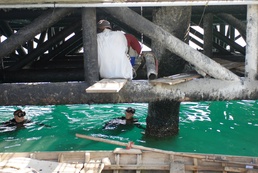
After one team did the assessment another went to work cleaning the supports before drilling holes for new rebar cages that add stability, while yet another team built wooden frames that will hold the concrete in place while it cures.
U.S. Army divers spend a lot of time training so they can handle complex tasks under stressful conditions.
Sgt. 1st Class Tracy Bower, team master diver for the 544th Dive Team, said, "Army divers have a pretty large mission. We generally support the Army Corps of Engineers with repair and work in water front facilities like dams and other areas throughout North America and we do also travel outside the country. We spend a lot of time training, Army divers have to be jacks of all trades."
The dive school in Panama City, Fla., is a six-month course. The first two months are diving-focused and the next four months are engineering-focused.
Working from the USNS Grasp, a Navy vessel with a civilian Merchant Marine crew, the 544th divers rarely set foot on land. They sleep on the ship, ride to the pier on Zodiac boats, and get to work in the polluted waters of the seaport here in Port-au-Prince. The hours are long, the bacteria levels in the water are high, and falling debris can make the work very dangerous.
These U.S. Army divers will be out of sight under the pier working to open this seaport so more supplies can be delivered until they complete the mission.