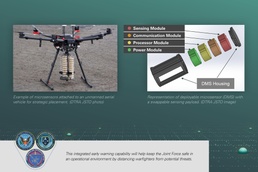
Academic and industrial research into microelectronics and chemical, biological, radiological, and nuclear (CBRN) detection methods has rapidly advanced the development of low-size, weight, and power (SWaP) sensors that can provide integrated early warning and situational awareness of potential hazards for the Joint Force with a reduced logistical burden. While these microsensors offer significant promise for the next generation of CBRN threat-detection methods, inconsistent standards for evaluating sensor performance have hindered transitioning the sensors from the lab to the field. The new Deployable Microsensor Pipeline will focus on identifying and systematically evolving detection technologies through continual market research, component-through-system-level testing, and operational assessments to quickly deploy this essential function.
To further drive innovation in CBRN threat sensors, the Defense Threat Reduction Agency’s (DTRA’s) Chemical and Biological Technologies Department in its role as the Joint Science and Technology Office (JSTO) for Chemical and Biological Defense, an integral component of the Chemical and Biological Defense Program, has partnered with the U.S. Army Combat Capabilities Development Command – Chemical Biological Center (DEVCOM CBC) to create a more standardized sensor assessment method called the Deployable Microsensor Pipeline to ensure that the technologies best suited to provide improved CBRN detection capabilities reach the field as soon as possible.
Microsensors are non-recoverable and readily deployable CBRN sensing capabilities that the Joint Force can strategically place around important routes, zones, and other areas. Installed either through staffed or unmanned platforms, the microsensors will communicate with one another, generating a networked array that can provide continuous area monitoring and mapping of CBRN threats. This integrated early warning capability will help keep the Joint Force safe in an operational environment by distancing warfighters from potential threats.
The Deployable Microsensor Pipeline focuses on four efforts to identify and evolve sensor technologies: