In July 1917, the Military Intelligence Division (MID) opened its New York City field office. Initially staffed by former New York Police Department (NYPD) personnel, the office was tasked with investigating domestic terrorism during World War I.
Approximately 2.5 million German-born immigrants and 4 million second-generation German Americans lived in the U.S. in 1915. While most were loyal citizens, the German Empire capitalized on the small percentage who sympathized with Germany at the dawn of World War I. Several espionage rings terrorized New York City between 1915–1916, bombing ships carrying American munitions and committing arson at munitions storage and packing plants along the harbor between New York and New Jersey. Prior to 1917, no federal laws covered espionage and sabotage operations during peacetime, so these cases initially fell on unprepared local police departments. After a German U-boat sank the RMS Lusitania in May 1915, President Woodrow Wilson ordered the Secret Service to take over. However, the Secret Service had limited experience with such investigations and failed to adequately safeguard against enemy sabotage.
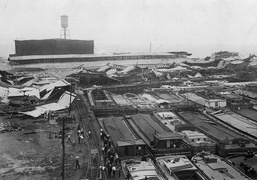
The worst attack occurred on 30 July 1916, when the depot on Black Tom Island in New York Harbor was set ablaze by three German saboteurs, including spy Lothar Witzke, who was later apprehended by the Army Corps of Intelligence Police (CIP). The depot housed approximately 2 million pounds of small arms and artillery ammunition and 100,000 pounds of TNT. The resultant explosion was the equivalent of a 5.0 on the Richter scale, and shockwaves caused damage to the nearby Statue of Liberty, Ellis Island, and Brooklyn Bridge. Four people were confirmed dead with more than one hundred injured. The incident dramatically affected American attitudes toward Germany and German American immigrants.
The final straw came in early 1917, when British cryptologists alerted the State Department of the infamous Zimmermann telegram. The telegram suggested the Germans intended to ally themselves with Mexico should America declare war. This would give Germany a foothold to enter the southern United States to continue its terror campaign. Soon after learning of the telegram, President Wilson declared war on Germany, and Congress passed the Espionage Act. This made sabotage operations a federal criminal offense and gave the MID and the Office of Naval Intelligence (ONI) responsibility for domestic sabotage investigations.
In July 1917, one month after MID established a security force in Washington, D.C., it opened its second field office at 302 Broadway Street in New York City to conduct counterespionage operations against such saboteurs. The MID justified its involvement in domestic investigations, stating, “the misbehavior, disloyalty, or indifference of native Americans is as important a material of military intelligence as any other.” As the CIP had not yet been organized, the MID had few experienced counterespionage agents. It instead sought local investigators who were familiar with the city and its particular security threats. Nicholas Biddle, the former head of the NYPD Neutrality and Bomb Squad, was made chief of the New York office and commissioned a lieutenant colonel.
The New York office was initially staffed by civilian investigators formerly of Biddle’s NYPD bomb squad. Over the next year, as more military personnel became available, it grew to include twenty-five Army officers, fifty-two CIP agents, fifty-one civilian detectives, and thirty-six clerks. By the end of the war, the office had arrested more than 500 suspected radicals and saboteurs. Colonel Biddle was awarded the Distinguished Service Medal in 1923 for his office’s role in “the failure of the enemy to thwart our military efforts in the City of New York by espionage, sabotage, and propaganda.”
Article by Erin E. Thompson, USAICoE Staff Historian. New issues of This Week in MI History are published each week. To report story errors, ask questions, request previous articles, or be added to our distribution list, please contact: TR-ICoE-Command-Historian@army.mil.