ROCK ISLAND ARSENAL, Ill. – The U.S. Army Sustainment Command recently unveiled a new temporary remote work policy. The new policy - which was in the development process for several months – aims to provide more workplace flexibilities and opportunities for current and future ASC employees.
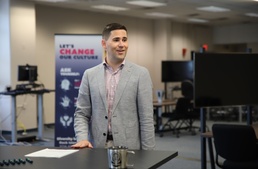
Matt Sannito, ASC deputy to the commanding general, has been an advocate for a policy offering more hybrid work environments, both to recruit new workers and to retain skilled, experienced workers of ASC.
Sannito said we have lost workers to companies and other commands that are more telework and remote work friendly.
“You can hear almost every Army senior leader talk about the fight for talent, and it’s absolutely true and it’s happening right now,” Sannito said. “Just in the last six months, we have probably lost a dozen superstars because they have found 100% remote work or 100% telework positions in other Army commands and other federal agencies.”
While teleworking has been available for many years at ASC, remote work – defined as an employee resides and works from a different geographic location than the official worksite and is not required to report to the regular duty station – is a newer opportunity for the workforce. There are different provisions for headquarters and subordinate organizations, but ultimately ASC views temporary remote work and office work as the same with the only difference being the location where the work is being completed and the tools used to accomplish required tasks.
The decision of whether an employee is eligible for temporary remote work is up to the individual and supervisor.
“It really needs to be a two-way conversation between the individual and the supervisor,” Sannito said, adding that more of the onus is on the employee to show why working in this different environment will improve effectiveness and satisfaction and productivity.
However, there is a two-level approval/disapproval authorization process, so if there is a dispute between an employee and their supervisor over the ability to temporary remote work, either the ASC deputy to the commander or the Army Field Support Brigade commander will make the final decision on eligibility.
Sannito said the new policy reflects the Army’s proven ability to acclimate, adding that “one of the aspects of the Army, is that it’s an organization that learns and adapts, and is open to different techniques, different doctrines, and different strategies.
“We absolutely saw a lot of benefits to having this more distributive workforce out and about (during the coronavirus), rather than the traditional come to a hard structure building.”
Sannito said the command’s new policy was necessary “to incorporate greater flexibilities so that an individual can have a voice in requesting (temporary remote work), and then empowering first-line supervisors to make those decisions.”
Lee Hansen, G1 (Human Resources) director, said offering flexible work environments, like remote work, as an enticement has changed the nature of job recruitment. In the past, Hansen said, when a G1 job opening was announced, he would receive perhaps a dozen or more responses from applicants. When one recent opening was announced, which offered remote working, “we had 575, and that was continental United States wide. Imagine the talents those 575 people could bring to the table.”
Hansen said that, while ASC is implementing what is becoming known as the “new normal,” there’s still a way to go. He said that, in the past year, seven G1 employees have moved to other commands because they offered more flexibility. That’s a trend ASC leadership wants to reverse.
“We are playing catch-up, and we can just hope the employees will be patient enough for us to get caught up.”
Sannito said the temporary remote work eligibility for employees will allow a better home/life balance and give some employees more freedom in terms of where they live while still working for ASC.
Several examples were cited where telework would help the employee and the command. One was that of a worker who needs to be close to and care for a parent, spouse, child or other family member. Another was someone who prefers to live in a different area of the U.S. Still another could be an employee who has a health condition that makes it difficult to travel back and forth to work but is otherwise capable of doing the job from their home.
Both Sannito and Hansen see a lot of positives coming from the new policy, and feel that the command and its employees, both current and future, will benefit.