By 1st Lt. Aaron Testa
16th Eng. Bde., USD-C
BAGHDAD - As U.S. military involvement in Iraq draws to a close, partnership with Iraqi security forces is becoming the lead focus.
Through partnership, U.S. forces are concentrating much of their efforts on advising and assisting their Iraqi army counterparts. Two units in Baghdad responsible for some of the most critical counter-improvised explosive device and engineering training are working to ensure Iraqi soldiers can execute their own missions as the landscape evolves and Iraqis take the lead.
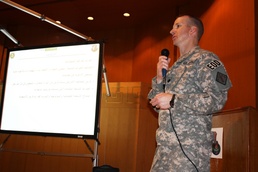
In order to provide Iraqi army partners with the tools needed to succeed, Soldiers from 16th Engineer Brigade and 79th Explosive Ordnance Disposal Battalion hosted a conference at Adnon Palace Jan. 19 to discuss the future. Organizers said the main thrust of the conference was to provide insight into what the transition should look like.
"This conference was a great opportunity for face-to-face discussion of the challenges U.S. and Iraqi army engineers and EOD are dealing with, the work-arounds, and the way ahead to the departure of significant numbers of U.S. engineers," said Brig. Gen. Glenn C. Hammond, III, commander of 16th Engineer Brigade.
Leaders from 16th and 79th stressed the need for taking advantage of all the training currently available because the current amount of U.S. Soldiers and training resources may not be available in a few months.
"We have a window of opportunity to continue with the training we are doing before we have to transition to a new format," said Lt. Col. Geoffrey Stevens, of Fort Hood, Tex., commander of 79th EOD Battalion.
According to Stevens, the number of U.S. ordnance disposal teams around Baghdad is expected to be reduced by the end of next summer, which will provide less training opportunities for more Iraqi units.
Meanwhile, some Iraqi army units are facing tough challenges innate to developing an effective system of supply and logistics. In response to these issues, organizers addressed the need for the Iraqi army to be fielded the necessary equipment and parts.
The partnership is not just about ongoing operations and training but also about sustainment operations, said Maj. Hal Kendrick, of Amherst, Ohio, logistics officer for 16th Engineer Brigade.
"This is a top down approach with about 60-70 percent (of it) complete at this time," said Kendrick. "If you don't have what you need, you can't do your mission."
The conference provided a valuable forum to openly and honestly discuss concerns related to training and equipping the Iraqi army engineer and EOD units, which will be at the fulcrum of future operations.
"This is not a combat war anymore; it is an engineer war," said Brig. Gen. Saleh Kadoori Salman, deputy director of Iraqi Field Engineer Directorate. "We are dealing with roadside bombs and terrorists."
Although the Iraqi forces are nearly ready to take charge of the operations, U.S. forces will continue to work to move the Iraqis forward toward self-sustainability.
"I look forward to the next conference to be held at the Iraqi army Engineer School at Taji to compare our progress with the remaining challenges," Hammond said.
As their partnership continues to evolve, U.S. leaders admit they may have achieved something greater than helping Iraqis rebuild their nation: they may have forged an enduring partnership for years to come.