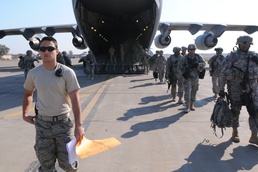
KIRKUK REGIONAL AIR BASE, Iraq — As a C-17 Globemaster III loaded with Soldiers and equipment lands on Kirkuk's airfield, aerial port Airmen assigned to the 506th Expeditionary Logistics Readiness Squadron are standing by awaiting the aircraft's arrival.
"Aerial port basically handles all of the aircraft that comes in and out of the base," said Senior Master Sgt. Sherita Johnson, 506th ELRS NCO in charge of the air terminal and passenger movement. "We inspect and load all of the cargo, process and handle all of the passengers, and we of course process all the information."
Once the aircraft came to a stop, the rear door began to lower and a specialized vehicle capable of moving 60,000 pounds moved into position to unload the palletized equipment. Within minutes, the cargo was moved and the Soldiers were led from the aircraft to the passenger terminal where they processed with their unit.
On average, the aerial port team moves approximately 470,000 pounds of cargo and processes more than 2,400 passengers each month.
Johnson said joint inspections, load planning, and keeping the aircraft on schedule are also responsibilities of the aerial port team.
"We have to maintain certain timeframes for each aircraft," said the sergeant deployed from the 41st Aerial Port Squadron, Keesler Air Force Base, Miss. "Each aircraft only has so many minutes on the ground, so we have to make sure we keep up with that as well."
Often times, an aircraft can only spend a short amount of time on the airfield so coordination takes place before, during and after an aircraft makes a stop.
"When an aircraft is getting close, command post receives the call and funnels that information to let us know they are about 15 to 20 minutes from landing," said Capt. Eric Wicklund, 506th ELRS operations officer. "That's when we start firing up the material handling equipment."
Once the aircraft taxis near the terminal, the aerial port Airmen work to get the aircraft on its way as quickly as possible.
"Most of the missions are what we call EROS, engine running on-load/off-load, which means they don't shut off the engines. They leave everything going, we pull up and do our thing, take PAX (passengers) on and off and send them on their way," added the captain deployed from the 86th LRS, Ramstein Air Base, Germany. "Generally we can clear a C-130 out of here in about 15 to 30 minutes."
Wicklund added that the air terminal operations center serves as the main coordination point for passengers and cargo airlift operations.
"The ATOC is the hub, the nerve center for what we do here," Wicklund said. "They keep their eyes on everything and orchestrate the whole process."
Aerial port Airmen work around the clock to ensure the continuous success of airfield operations while providing the gateway for mission essential cargo and deploying service members.
"Every Airman that comes in and out of this base, comes through us," Wicklund said.