BAGRAM AIRFIELD, Afghanistan - Imagine you're snug in your warm bed in the cold early morning hours only to be awakened by a loud voice that sounds outside; "Code purple, code purple, mass casualty in the casualty collection points," the voice repeats.
You scramble to dress and assemble your combat lifesaver gear as fast as you can. Then run to the CCP to assess the current group of mass casualties with an array of injuries.
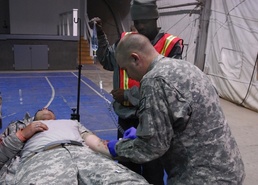
This is the training that Task Force Cyclone combat lifesavers went through during a quarterly scenario at Bagram Air Field, Afghanistan, Nov. 13.
Seventeen Soldiers from the task force went through a month-long process to review remember test their combat lifesaver skills. The blocks of instruction include on site processes, assessment of casualties and hands-on emergency treatment.
The exercise was base-wide and included multiple task forces, security personnel and medical professionals. Task Forces Thunder, Lightning and Med participated in the exercise, while Combined Joint Task Force — 82 oversaw the operations.
According to Army Maj. Michael Fenchak, Task Force Cyclone medical operations officer, this exercise was in preparation to assist on-post hospitals and medical personnel with a MASCAL event.
"The purpose owas to coordinate actions of individual CCPs in order to work in synch with the Craig Joint Theater Hospital in the event there is a catastrophic event on BAF with causalities greater than the Hospital can handle," said Fenchak.
Task Force Cyclone's medical non-commissioned officer-in-charge, Army Staff Sgt. David Irving, worked closely with Army Sgt. Isaac Jones, Kentucky Agri-business Development Team medical NCOIC, to develop a challenging training plan for the Soldiers.
"Most CLSs only get training once a year. But, by doing these additional exercises they can better react and treat if we have an actual mass casualty," said Jones, a resident of Lexington, Ky.
According to Irving, by repeating the steps and processes of a CCP and practicing the motions of how it all operates will become routine functions for the Soldiers.
"It's all about muscle memory. If you set it up the way you tear it down the same way, it's going to become repetition," Irving said. "That's what happened today. Everybody knew exactly where everything was supposed to go. They immediately started doing it and it was awesome."
The task force Soldiers who participated said they feel more comfortable with their abilities to assist casualties.
"It's a very good experience and we'll definitely know what to do if one does happen," said Army Sgt. Benjamin Hermus, a help desk NCO from Speedway, Ind. "There's no real way to expect what's going to happen at a MASCAL. But at least we will be a little calmer about it and know exactly what we're supposed to do if that time comes."
Both medical NCOs were impressed with the performance of the Soldiers, and Irving was especially thankful for the assistance of the Kentucky ADT who played the part of the casualties in the scenarios.
"I think all of our Soldiers did awesome-rific, especially for a group of folks that have had no medical training [except CLS]," Irving said. "They're perfect, they were great. We couldn't have done it without the Kentucky guys."