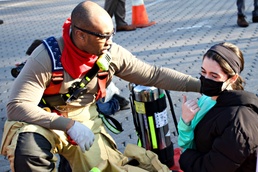
Screeching ambulances, writhing, wounded role players and emergency responders rushing to action – Maroon Surge 22 presented a fast-paced, collaborative challenge to U.S. and host nation participants at Landstuhl Regional Medical Center (LRMC) on March 10, 2022.
The exercise included more than 200 participants, including Fire & Disaster Control Rescue Service from the 86th Airlift Wing at nearby Ramstein Air Base, German emergency responders from neighboring cities, and observers from host-nation trauma systems.
Dr. Aaron Harris, Chief of Community and Global Health Engagements for LRMC, said the exercise enabled collaboration and integration with host-nation partners.
“We see three trauma systems from Saarland, Rhineland Pfalz, and the German Bundeswehr (Armed Forces Medical Service) all converge right here at LRMC today,” said Harris. “These exercises allow us to confront the (challenges of medical support overseas) for our patients, so they have the high-quality patient-care experience they need and deserve. It’s a wonderful opportunity for us to learn together.”
The emergency scenario featured a massive vehicle rollover with nearly two dozen simulated causalities requiring immediate on-site medical evacuation and hospital care. Participants transferred the casualties to LMRC’s Emergency Operations Center to receive simulated treatment from hospital staff.
Col. Prof. Dr. Eryin Kollig, the Bundeswehr Medical Service Clinical Director for Orthopedics and Trauma Surgery, offered personal input on the value of joint training exercises based on his previous combat experience in Afghanistan.
“We learned in our deployments that there is a huge advantage when you train as you fight. These exercises are extremely important to team-building. You must rely on each other. Every action must be performed properly and perfectly. This can only be guaranteed if you have trained together.”
Joint medical response exercises enable U.S. forces and allied partners to coordinate mutual activities, maintain connections and achieve interoperability in support of U.S. national security policy and military strategy. Emergency response opportunities empower participating staff and host-nation partners to improve overall organizational and individual readiness.