Just Add Water
Defense Threat Reduction Agency's Chemical and Biological Technologies Department
Courtesy Story
Date: 09.30.2021
Posted: 09.30.2021 20:03
News ID: 406469
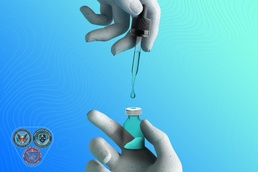
Advancements in biomanufacturing are bringing on-demand, shelf-stable vaccines to the front lines.
By the year 2050, it is estimated that up to 10 million people will be threatened by drug-resistant bacteria. Thanks to recent research investments by the Defense Threat Reduction Agency’s (DTRA) Chemical and Biological Technologies Department in its role as Joint Science and Technology Office (JSTO) for Chemical and Biological Defense, there is an innovative way of creating vaccines quickly with no need for refrigeration—iVAX, short for in vitro conjugate vaccine expression—solves the issues surrounding traditional conjugate vaccines.
A conjugate vaccine contains a specific part of the bacteria or virus that trains the immune system to provide protection, which is attached—or conjugated—to a carrier component, and this ensures the vaccine is stable in the body and properly transported. Although conjugate vaccines are one type of vaccine shown to be effective and safe for preventing life-threatening infections such as meningitis and pneumonia, they come with manufacturing and distribution challenges:
- Conjugate vaccines are difficult and expensive to make. They require large-scale, costly manufacturing facilities that include biosafety measures.
- The conjugating step can change the architecture of the necessary bacterial component, which makes the conjugated vaccine considerably less effective.
- The entire process from manufacturing to distribution requires refrigeration.
Collaborative groups led by Dr. Michael Jewett of Cornell University and Matthew DeLisa of Northwestern University have developed a cell-free protein synthesis (CFPS) system for vaccine production. This portable technology uses freeze-dried materials that can be activated at the point of care with simple rehydration, which is a significant bio-manufacturing technology advancement as it increases the speed for producing vaccines and eliminates the need for refrigeration.
This innovative research in developing CFPS systems will shorten vaccine production timelines in some cases to as little as one hour. DTRA-JSTO plans to invest further with these collaborative groups to advance CFPS capabilities using artificial intelligence and machine learning to design proteins capable of binding multiple targets onto disease-causing bacteria and viruses, which would significantly increase the immune system’s ability to expel them.
Additional information about iVAX background, rationale, and methodology are in the article, “On-demand biomanufacturing of protective conjugate vaccines,” published in the prestigious, peer-reviewed scientific journal Science Advances (February 3, 2021).
POC: Revell Phillips, Ph.D., l.r.phillips.civ@mail.mil