CAMP TAJI, Iraq — Through a growing foundation of trust, friendship and detailed planning, two separate armed forces have taken their abilities to higher levels.
The leadership of 1st Battalion, 227th Aviation Regiment, 1st Air Cavalry Brigade, 1st Cavalry Division, has spent the last six months working with 2nd Squadron of the Iraqi air force — strengthening bonds.
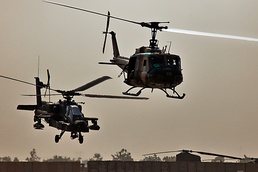
This close relationship between U.S. military aviators and the IAF resulted in two AH-64D Apache attack helicopters and two Iraqi UH-1 helicopters flying in formation together on a mission over Baghdad, Oct. 21, to display the combined strength of the partnership.
The main goal of the flight was to reiterate the trust between both the 1-227th and 2nd Squadron, said Lt. Col. Charles Dalcourt, from Baton Rouge, La., commander, 1st ACB.
"We want to show the Iraqi people, through this flight demonstration, that we're linked together," Dalcourt said. "Our relationship is solid and the Iraqi air force has emerged as a premier and pre-eminent force here in Iraq for movement of their troops."
Dalcourt said he established a relationship with 2nd Squadron on his last deployment to Iraq, which made the day a special one.
"This day has evolved through a lot of work over the last three and four years," Dalcourt said. "To come to this point is not only a great sign of progress, but also a great sign of the mutual trust that has developed between the United States Army and the Iraqi air force."
The American aviators took a step towards the background as the Iraqi pilots ran the mission briefing and took the lead on the flight itself, showing the ability of the Iraqi air force to stand on its own, Dalcourt said.
"They are very competent pilots and many of them have upwards of over 5,000 hours [of flying]," Dalcourt said. "They've fought in the Iraq-Iran war and they've been fixed wing as well as rotary wing aviators, so they're very capable."
Chief Warrant Officer 4 Frank Almeraz, from Albuquerque, N.M., the standardization pilot in 1-227th, said although the Americans offered assistance, the Iraqi's briefed the bulk of the mission themselves.
"We discussed the differences between the [Iraqi] air force and Army, but we tend to be more similar in the way we do things than I thought," Almeraz said.
The joint mission was the first step in what Almeraz hoped would be a series of similar flights.
"Today is a plain, just getting started type of scenario," Almeraz said. "We want to continue doing these missions and hopefully they'll [the IAF] become more detailed."
After numerous deployments, Almeraz said this was the first time he had flown an Apache alongside a Huey
"This is my fourth trip to Iraq ... my third at Taji and we've never been able to do a joint mission together," Almeraz said. "Sometimes we would do stuff where they would come from one side and we'd come from another, but we wouldn't really mix. Today we will be part of the same formation."
Flying in formation shows the advances made by both sides, Almeraz said.
"From the first time we came here, this is the point we wanted to get to," Almeraz said. "It shows the progress between the Iraqi air force and the [U.S.] Army."