During military specialty school, Marines learn the basics, but their education does not end there.
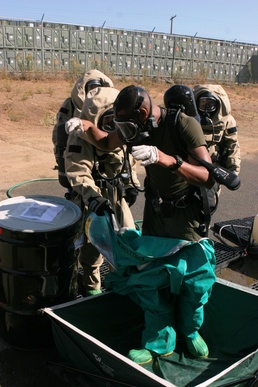
Fourteen chemical, biological, nuclear and radiological defense specialists with Headquarters Company, Combat Logistics Regiment 17, 1st Marine Logistics Group, are participating in a five-week course that started Sept. 28, to earn the state of California hazardous material specialist certification.
"This training is a hazardous materials consequence management and response course to update Marines on the latest civilian standards on dealing with hazardous materials and/or terrorist actions involving chemical, biological, nuclear and radiological incidents," said Lance Cpl. Craig R. Cliburn, a CBRN defense specialist with Headquarters Co., CLR-17, 1st MLG, 21, from Chicago. "The training is geared toward more common industrial chemicals compared to mission oriented protective posture gear, which is meant for warfare involving chemical agents."
Marines need to be protected from hazardous industrial chemicals to include chlorine, sulfuric acid and ammonia.
After graduating the course, CBRN defense specialist Marines will be able to work side-by-side with civilian hazardous material specialists in California. Doing the training will enable Marines to support cities surrounding the base in the event of an incident involving hazardous materials.
"The Marines will be doing three scenarios where they'll understand the situation, gather information and determine what substance is in the environment," said Cpl. David Mikulec, a CBRN defense specialist with Headquarters Co., CLR-17, 1st MLG, 21, from Dallas.
Marines will conduct a variety of training scenarios in the CBRN warehouse, 22 Area boiler room and 33 Area waste water treatment plant. They will be using new equipment and strategies to qualify for the course. The CBRN Marines must also take a written test along with hands-on training to become certified.
In the 14 Area warehouse scenario the Marines wore chemical protective suits, and using air tanks to breathe, entered the building, assessed the situation and evacuated the causality.
"It's pertinent to equal the state of California's training standards and the CBRN Department of Defense certification," said Gunnery Sgt. Arthur C. Singletary, CBRN defense specialist, with Headquarters Co., CLR-17, 1st MLG. "Chemical, biological, nuclear and radiological defense specialist Marines may be thrown in a situation in Iraq or Afghanistan where they would verify a safe area for combat troops to maneuver around in."
No matter where CBRN defense specialist Marines are tasked to do a mission, their goal remains the same - protect people from hazardous materials.
Singletary, 41, from Hamilton, Ohio, stated that he wants each and every CBRN Marine here to take away the vital role of not only protecting the Marines, but also the nation.