HOUSTON, Texas. – U.S. Space Force is quickly gaining new recruits as they seek out and select applicants from within the present military forces. The application process is often simple and even offered to those individuals who are eligible because of their current career field and professional competency.
“The opportunity arose in May of 2020 for us to apply because we were common between both the U.S. Air Force and the U.S. Space Force,” said Staff Sgt. Ayla Wentland, a Cyber Transport Systems Supervisor with the 726th Air Control Squadron, Mountain Home Air Force Base, Idaho, and a Goodyear, Arizona native. “It was a pretty straightforward process; an email was sent out if you were eligible, you would then choose to apply and send in a letter of recommendation from your commander.”
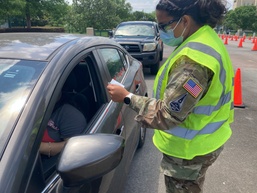
Wentland is one of many young and eager Airmen willing to give the U.S. Space Force a mission-ready stance. She is one of three Guardians attached to the 64th Expeditionary Medical Operation Squadron at the Community Vaccination Center (CVC) at the NRG Stadium in Houston, Texas. They blend in well with their occupational camouflage-patterned duty uniforms, highlighting similar variations in style as seen between the Air Force and Army uniforms. Guardians sport blue U.S. Space Force nametapes, rank, and a Space Force patch worn on the left shoulder below a bright gold-fringed flag.
On average most applicants are waiting anywhere from five months up to an entire year before hearing back that they have been selected. Wentland remained until December before heading back.
“I didn't make that first cut, and I didn't even find out I had been selected until February via the supplemental program,” Wentland said. “So that means enough people had either gotten out of the Space Force, declined the offer to join once accepted, or had been kicked out, that they came through with another selection process, and I made that cut.”
“You know, finding out about the opportunity to transition was kind of like, ‘hey, it's real, if I want to apply, all I have to do is speak up,’” said Specialist 3 Darnell Hanner, All Source Intelligence Analyst, 347th Operation Support Squadron, Moody AFB. “The recruiters had videos for us to watch, but because it’s the intel community, we were limited as to how many of our questions could be answered."
An all-source intelligence analyst like Hanner is under a legal agreement that he never discloses classified information to unclassified sources. Therefore, his vague descriptions relating to work are fitting.
“Exactly what my work would entail isn’t something I can talk about or entirely know before it begins,” Hanner said. “Without being on the inside and under the protection of a security clearance or need-to-know basis, there's no way of knowing what I'll be doing before I cross over.".
Hanner swore in this past February and, like his two Guardian peers, has yet to receive new orders. Most Space Force recruits will be finishing out their current duty station assignments before taking a position with a Space Force unit. This will ensure that current manning requirements will continue to be met for the Air Force as they support the Space Force through the balance facilitating Space Force recruitment with Air Force retention. ,
“I’ll be doing the same thing for the Space Force as I do in the Air Force,” Hanner said. “You know it’s not like we have a crystal ball, with all source intel operations, we assess information from all the intel specialties and then make an assessment of the situation as we understand it.”
Hanner, a fellow Houstonian, volunteered to come home for the COVID-19 vaccine deployment after learning that a volunteer was needed to replace someone who had left.
"I didn't even know what the mission was, but I'm from Houston, so I wanted to go no matter what,” Hanner said. “I’ve enjoyed being back home, and it felt good to have a few family members and friends come by to see me, give me a hug, and congratulate me on making it in.”
Space Force slots are highly curtailed towards cyber warfare, and joining through a branch like the Air Force, which often chooses for recruits what job capacity they will serve in, makes a current career track to the 6th branch of the Military via enlistment a bit of a gamble.
"When I signed up for the Air Force, I wanted to join the Space Force,” said Specialist 3 Jesus C. Lopez, Cyber Surety, 325th Communications Squadron, Tyndall AFB. “I was secretly hoping that I could apply though there wasn’t any application available at the time.”
Lopez, like many, has been inspired to join the Space Force since the announcement of its inception by President Trump in 2019. Lopez shared that he was happy to join the Air Force; nonetheless, it was an exciting opportunity to learn that he would get to apply for Space Force.
“I joined the Air Force on Jan. 14, 2020,” Lopez said. “During our final phase of BCT, they started to ask us who wanted to join Space Force; my friends and I were some of the few that signed up. I didn't hear back until somewhere around September, November.”
After receiving an email with a list of around 2,000 names on it, all of whom were accepted, Lopez, like Wentland, discovered his name was absent.
“I knew people who had received a letter informing them that they had not been selected,” Lopez said. “But I hadn’t, so more time goes by, and then around March 15th, I get a call from my supervisor. He said, ‘hey, guess what? You got accepted into Space Force.’ I logged onto a computer and accepted the offer that same day."
For now, Space Force is selecting many of its recruits Space Force from the Air Force. However, it is possible to apply if you have prior relevant military training. However, not everyone is staying Enlisted.
“I had always wanted to be an Officer, and after beginning my military career in the Army, I transitioned to the Air Force,” said Airman 1st Class Bohao Li, a Patient Administration Technician, with the 9th Healthcare operations Squadron, out of Beale Air Force Base. "I applied for Officer Training School but later discovered opportunities to work in Space Force as an officer. I went to my leadership and asked them if it was possible to convert my application to a Space Force OTS application instead. They were more than happy to help.”
Li is also working at the CVC and, since arriving, received word of his acceptance to attend the Space Force Officer Training School, but he isn’t your everyday junior enlisted Airmen. With two masters’ degrees, one in polymer engineering and the other in material engineering, Li has the upper hand in the selection process, granting him skills and knowledge to build his new career as a Space Force Officer.
"In the future, I believe there won’t be a need for warfare which requires bloodshed,” Li said. “It's now possible to do a lot of damage to our adversaries without sacrificing any human life. That's the future of warfare."
U.S. Northern Command, through U.S. Army North, remains committed to providing continued, flexible Department of Defense support to Federal Emergency Management Agency as part of the whole-of-government response to COVID-19