BAGHDAD — A heavy fuel truck is involved in a major traffic accident, spilling hundreds of gallons of fuel into a nearby waterway.
This is just one of the many simulated scenarios that played out at the first hazardous materials course at Baghdad's National Fire Academy on Aug. 11. Provincial Reconstruction Team-Baghdad members invited MND-B Soldiers to teach Iraqi firefighters techniques on how to handle Haz Mat emergencies.
"The Iraqis do not have a Haz Mat program. We're trying to plant the seed in the foundation to create one here," said Lt. Col. Lee Lavespere, of Pineville, La., 225th Engineer Brigade, a course instructor. "This is the first time they see this type of training."
Lavespere, a civil capacity liaison with the Joint Reconstruction Operations Center, said a clean environment should also be a goal for the future of Iraq and he is hopeful that this course will set the stage to start up an official Haz Mat response program here.
"[The Ministry of Interior] know we're here and U.S. forces stand ready to partner with the Ministry to get this going," said Lavespere, a former environmental specialist for the state of Louisiana.
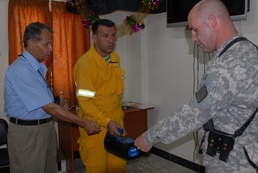
Iraqi firefighters attending this two-week training program focused on health and safety planning, decontamination and first aid, techniques for proper response at a hazardous materials site, monitoring and sampling, and hands on instruction on the latest chemical detection equipment.
"They are eager to learn," said Staff Sgt. Jason Smith, San Antonio, Texas, with the 110th Chemical Battalion. "They are very professional and share their experiences about responding to emergencies. If we can teach them Haz Mat response, maybe they can clean up the entire country."
As oil production comes back on line throughout Iraq, it increases the chances of Haz Mat emergencies, and it also places more emphasis on the need for coordinated government emergency response. Smith and Lavespere said a Haz Mat program could be an important step toward protecting the people of Iraq. And this first class of Iraqi firefighters to graduate from this Haz Mat course could be that 'seed' to help develop a national program.
"Maybe the leadership of the fire departments will establish a program, maybe they will pass it up to the Ministry of Interior," said Smith. "There is a need for this. This is important."
"Our eventual goal is to arm [Iraqi firefighters] with what they need to protect themselves and the public around them," said Lavespere.