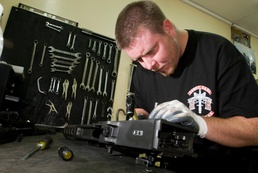
JOINT BASE BALAD, Iraq — Walking through the doors of the 402nd Army Field Support Brigade's Small Arms Support Center, the smell is unmistakable — the salty, acrid scent of weapons cleaner and lubricant fills the air.
Since May 2005, the Soldiers and civilians working here have done more than simply fix weapons for the one or two problems they were brought in for; each time a weapon is serviced, it is carefully inspected for anything the operator might have missed.
"Instead of just checking to make sure that the weapons function ... we're making sure they're perfect," said Spc. Clancy A. Pratt, a Soldier from the 699th Maintenance Company, a unit from Fort Irwin, Calif., who has worked at the center for the last four months. Pratt said that in the time he's been at the center he can't recall when a weapon was ever returned for the same fault it came in with.
Pratt, who is a resident of Lebanon, Ore., is one of three Army Soldiers who work at the support center alongside seven Department of the Army civilians from Anniston Army Depot and the U.S. Army's Tank-automotive and Armaments Command. Together, they service a full spectrum of Army weapons ranging from a pistol to a 120mm mortar.
To date, the facility has repaired more than 30,000 weapons, issued at least 8,700 more, while maintaining an inventory of nearly 600 weapons-replacing weapons which can't be repaired.
"We are the only location in theater that, if we cannot repair a weapon, we can replace it on the spot," said Michael D. Cohorst, the site lead for the support center.
While the staff at the repair center can fix many weapons — sometimes rebuilding entire guns from a bare receiver and a box of parts — there are some weapons that cannot be fixed in theater. These are shipped back to Anniston for repair and rebuilding.
Cohorst said the M2 .50-cal machine gun is one weapon his shop sees often, and a lot of the problems are directly related to damages caused by improper headspace and timing — both of which must be verified before every mission, or when the barrel is removed or replaced.
"The weapon has been around a long time, but the problems are the same," Cohorst said. "It's proper headspace and timing."
Part of the support center's mission includes installing special Army-mandated modifications to certain weapon systems — such as an upgrade for the M2 that gives the weapon a manual safety on the weapon's back plate.
For the last 80 years, the "flex-mounted" variant of the M2 — a moveable version of the weapon commonly used on humvees and MRAPS — lacked any safety to prevent the weapon from firing when the trigger was pressed. It wasn't until recently that an actual safety was designed for this variant of the M2 — a feature the support center here can install or train direct support level personnel to perform for their units. These kits are issued to direct support units after coordination with the SASC, Cohorst said.
Although the center services weapons from any military branch, it can only swap out entire weapons for Army units.
The 402nd's small-arms support center also provides a unique learning opportunity to many Soldiers who work here alongside the experienced workers from Anniston.
"I spent a year over in Korea," Pratt said. "That whole year hasn't touched what I've learned in the last four months."