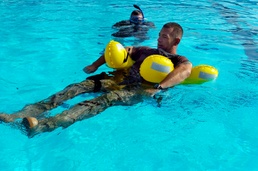
GUANTANAMO BAY, Cuba — When new equipment is introduced to the individual military branches, classes and hands-on training are conducted to ensure each service member understands how to use it.
For the Coast Guard Maritime Safety and Security Team 91101 from Seattle, Wash., it is no different. Coast Guard-wide, changes are being made in regard to current life vests worn by Coast Guardsmen when underway.
The MSST's mission for the next six months is to support Joint Task Force Guantanamo with water and land security. Like all other service members here, when new equipment is introduced, training must occur.
"Our Tactical Flotation Support Systems are changing and the change will enhance our ability to carry out our mission here in Guantanamo and continue with us when we return home," Coast Guard Chief Warrant Officer Brian Mackey, assistant operations officer, MSST said.
The new flotation devices will be worn around the waist on the belts that Coast Guardsmen use to attach various tools they need to carry out their mission. The devices are about the size of a canteen.
"The changes to the flotation devices actually give us a more positive buoyancy rate," Mackey said. "With the old ones our buoyancy rate was about 35 pounds, but with the new ones we have a positive buoyancy rate of 80 pounds. This is helpful, since the idea is to keep service members afloat even when loaded down with mission-essential gear and the added weight of body armor."
The training sessions for Coast Guardsmen will be held at different times over the course of the next week.
"During the different training sessions held at the Windjammer Pool, service members will don body armor and the new flotation support systems," said Coast Guard Chief Petty Officer Jason Jablonski, waterside division officer, MSST. "They will jump in and tread water for one minute. Afterwards, the service members will exit the water and make any adjustments to their gear as necessary, jump back into the water and sink to the bottom of the pool. Once they hit the bottom they will then deploy their flotation devices, which will bring them back to the surface of the water."
Training is an ongoing process no matter what branch of service a member serves.
"Training is important to our service members," Mackey said. "Our service members need to know how to wear and use their equipment as well as build confidence in the gear that could save their lives in an emergency or combat situation."
Coast Guard Petty Officer 3rd Class Jessica Martin, a coxswain with the MSST, completed her training July 24, 2009.
"They are kind of big when they deploy, however, they will keep you afloat," Martin said. "I think I will like them better though; they take up less room than the old ones."
The Coast Guardsmen will start using the new flotation devices immediately.
"Although, changes are sometimes different and can be difficult for some, I have every confidence in our service members that they will continue working hard to serve the JTF and adjust to the new gear with little difficulty," Mackey said.
For more information about Joint Task Force Guantanamo, visit the Web site at www.jtfgtmo.southcom.mil