MARINE CORPS BASE CAMP PENDLETON, Calif. — Every summer, some college students have four weeks to get a taste of what it's like to be in the Marine Corps or the Navy. They are not obligated to stay in the program and can give up at anytime and return to civilian life. But for those who choose to stay in and complete the program, these men and women could be the future officers of the Navy and the Corps. These college students are Naval Reserve Officer Training Corps midshipmen.
In order for the students to stay in the program, they must participate in the Career Orientation Training for Midshipmen every summer, a month-long program that takes midshipmen to different military bases and shows them what service members do on a daily basis.
"The purpose of the Career Orientation Training For Midshipmen, or as we called it CORTRAMID, is to motivate them to stay in the [ROTC] program," said Capt. Ted Corbeill, a Marine officer instructor with Iowa State University Naval ROTC, 36, from Southfield, Michigan.
The four-week program is broken down into four parts: surface week, which they stayed on a surface ship; submarine week, which they dive into the deep unknown in a submarine; aviation week, which midshipmen learn about various aircraft the Navy and Marine Corps operate; and Marine week, which they learn and conduct a variety of training exercises.
With Marine week being spent at San Mateo here, they experience the life of a Marine, receive guidance and get classes on what it takes to be a Marine directly from the Marines who live and work here.
"By far, Marine Week is definitely my favorite week," said Garrett Q. Bentley, a midshipman of Norwich University, 20, from Grass Valley, Calif. "The Marines are so helpful, we get step-by-step, clear instructions and they allow us to have hands-on experience."
The midshipmen were divided into three platoons and rotated with one another as they went on with training so they could become familiarized with the various gear and weapons.
"In our group, we explain to the midshipmen about [Chemical Biological Radiological Nuclear] in the Corps and show them the equipment we use," said Lance Cpl. Daryn W. Yoshihara, a CBRN defense specialist with Headquarters Company, Combat Logistics Regiment 17, 1st MLG.
Some of the equipment included Mission Oriented Protective Posture, or MOPP, which is protective gear worn to help protect against chemical or biological attack. MOPP gear includes a gas mask, over-garments, over-boots and gloves. There are five different levels of MOPP, 0-4, with four being the most crucial and requires the entire suit to be worn.
Marines with CBRN, HQ Co., CLR-17, 1st MLG, explained the safety hazards and procedures to midshipmen. They were on stand by and always prepared to answer any question midshipmen had.
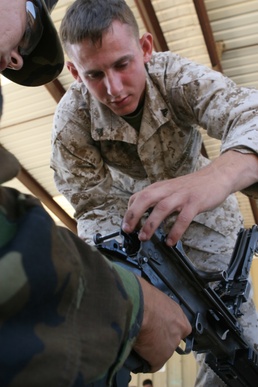
While a group of midshipmen was listening to the importance of CBRN equipment in the Corps, another group got a chance to get their hands on various weapons.
Their favorite part of the week so far, they said, was being able to disassemble and reassemble the M-240B and the M-249 Squad Automatic Weapon, and firing simulated weapons in the warehouse. They said they looked forward to going out to the range to fire live rounds sometime during their training here.
Further out in the field, another group received instruction on various types of vehicles in the Corps and how they operate, down to their usage and safety. The vehicles on display in San Mateo included the A-1 Gun Truck, the MK-23 Medium Tactical Vehicle Replacement 7-ton truck, the mine resistant ambush protected vehicle and the 4x4 Cougar.
"We teach them how to avoid [improvised explosive devices] and basic needs for survival being a [Motor Transport Marine] in the Corps," said Lance Cpl. Tyler J. Johnson, a Motor-T operator with HQ Co., 5th Marine Regiment, 1st Marine Division, 19, from Grand Junction, Colo.
The purpose of traveling to various Navy and Marine Corps units is to help the midshipmen decide in which branch they'll serve.
"We want to ensure that they make an informed decision toward service assignment," said Yoshihara, 22, from Mililani, Hawaii.
Marines with 1st MLG took the midshipmen around to show them what it's like to be Marines, and brought them to the field to prepare them with the knowledge and gear necessary for the training.
With the help of these Marines and the program, these men and women, some of whom may soon become the future leaders of the Corps, understand a little more about what it's like to be a Marine and what it means to be a warrior.