BAGHDAD — It's a place that is tainted with seven years of conflict, where dust storms are commonplace, and clean, refreshing water is a scarce commodity.
U.S. forces donated much-needed equipment to the office of the Abu Ghraib Director of Irrigation in an attempt to address the Middle-Eastern country's water supply issues during a meeting on a military compound in Baghdad, July 15.
Soldiers with Special Operations Task Force — Central and Multi-National Division — Baghdad's 403rd Civil Affairs detachment have been working together to increase the ability of the government of Iraq to continue the reconstruction efforts as the American forces begin to leave Iraq.
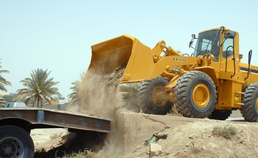
After fusing their efforts, Capt. Steve Davies and Capt. Stephen Nemmer were able to acquire and transfer a brand-new wheeled excavator and loader into the hands of concerned Iraqi citizens.
Underneath the scorching sun producing record-high temperatures, a yellow flat-bed truck drove through a fortified gate and rolled over loose gravel to pick up the equipment.
"This equipment will support ongoing initiatives of the Ministry of Water Resources," said Davies, the SOTF-C civil affairs officer. "The Abu Ghraib Director of Irrigation will be taking possession of this equipment and supervising its use for various capacity-building projects throughout his entire area."
It is a vast area of responsibility that stretches from Fallujah in the west, to the northern reaches of Abu Ghraib, and south through the Nahia of Yousefiya, continued Nemmer who is also commissioned in the civil affairs branch.
"This project will improve the maintenance capabilities of the Irrigation Department to ensure that the irrigation system continues to provide water along the entire length of the canals," Nemmer said. "This canal system irrigates over 170,000 donum of farmland.
"Ensuring that the canal system works from beginning to the end will definitely help," Nemmer concluded.
A representative of the office of the Abu Ghraib Director of Irrigation and Chief of Engineer Hatin Ali said that the department needs the equipment to effectively reopen the canals that have been closed, remove illegal taps that the farmers put on the pipelines, and keep irrigation canals clean in a quick manner.
Before this project became a reality, the captains sat down and did some planning because they wanted to make the largest impact possible during a time when Iraq has taken full responsibility of all aspects of government.
"We discussed several projects, but decided that this equipment would provide the most impact to the reconstruction effort," Davies recalled. "As the U.S. takes a back seat, the Iraqis are taking the lead and are now shouldering the lion share of the work. We decided that providing capacity-building equipment like this was the best way to equip the Iraqi people who will be continuing the reconstruction efforts over the coming decades."
Currently there is extensive work being done in order to provide clean drinking water through the construction of water purification plants. According to Nemmer, a large percentage of those facilities draw their water from irrigation canals that the donated excavator and loader will make more efficient.
Davies claimed that the irrigation systems not only will allow for clean water, but will also increase agricultural capacity in an area where the majority of income stems from agricultural production.
"Like most Soldiers here in Iraq, we have sacrificed years away from our family and invested them into the country of Iraq with the hope that our hard work would result in something exceptional," said Davies whose first deployment was in 2003. "When I first arrived in Iraq I viewed Americans as "us" and the Iraqis as "them." As I have invested myself in Iraq over the last six years, my perceptions of Iraq have evolved and I have many Iraqi friends that I will remember fondly for the rest of my life."
Davies stated that he has met many talented Iraqi men who desire to see their country prosper. He said that he is privileged to have a job where he can continue to help the Iraqi people and by doing so he is "taking steps to secure all of the hard work that has been conducted since 2003 and ensure positive results continue into the future."
"Wanting to be great does not make someone great. Hoping for success does not guarantee success," Davies explained. "There is a lot of hard work ahead in order for Iraq to move forward.
My hope is that the investments U.S. forces made in Iraq and its leaders will come to fruition and Iraq will be the better for it."
All of the people involved in the project were in agreement.
Ali remains optimistic that in the future, sooner than later, all the people who left the country will come home and friends who helped build this country will visit a new and improved Iraq. Although they are inevitably going to leave, he hopes coalition forces always remember what they did for the people here.