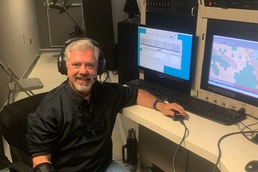
"Old soldiers never die, they simply fade away," said retired General of the Army Douglas MacArthur; however, retired North Carolina Army National Guard Chief Warrant Officer 4 Ed Sanderlin never got the memo. Sanderlin served state and nation for over 27 years on three continents and still continues as a North Carolina National Guard (NCNG) AH-64 Apache Longbow Crew Trainer (LCT) operator.
In a corner of the NCNG's Army Aviation Facility in Morrisville, North Carolina, you will find a bank of computers, high definition monitors, and an Apache helicopter cockpit, that make up the LCT. Both the LCT and Sanderlin, are there to keep NCNG aviators ready to deploy on a moment's notice, and it is debatable if the man or machine knows more about flying.
Sanderlin's career reads like a novel, 27 years in uniform, six overseas deployments including Germany, South Korea, Bosnia, and combat in the Gulf War and Iraq. He served as a standardization pilot, instrument examiner, electronic warfare officer, and battalion master gunner. He completed multiple combat missions, including the rescue of a fellow pilot in the Gulf War, earning Sanderlin the Distinguished Flying Cross, cited for "heroism or extraordinary achievement while participating in an aerial flight."
In 2010 he retired and began a civilian contract job instructing aviators in and operating the LCT.
"No matter how strong a pilot you are, when you leave a simulator period with Mr. Sanderlin, you have learned and learning makes us better," said North Carolina Army National Guard Maj. Bethany Barden, administrative officer, 1-130th Attach Reconnaissance Battalion.
After such a record of achievement, most would enjoy a well-earned retirement; however, Sanderlin came out of retirement in 2018 to join his former unit for one last deployment to Afghanistan.
He brought his years of training and experience to C Company, 1-130th Attack Reconnaissance Battalion attached to the 101st Combat Aviation Brigade, 101st Airborne Division deployed to Bagram Air Base. There he served as an instrument examiner, a standardization instructor pilot and mentor to younger pilots and aircrew.
He retired, for apparently the last time, in April 2019.