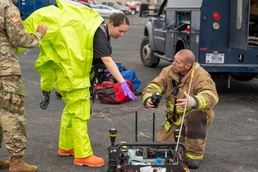
MIDWEST CITY, Okla. - The 63rd Civil Support Team, Oklahoma Army National Guard, conducted interagency training with the Midwest City Fire Department in Midwest City, Oklahoma, Nov. 19, to increase agency interoperability, share best practices and streamline their response efforts for hazardous material spills.
During the training scenario, the Midwest City Fire Department responded to an industrial metal workshop that had been notionally damaged by a tornado. Upon arrival, the firemen surveyed the damaged area to locate any potential chemical spills. Once hazardous materials were identified, the 63rd CST was called in to assist the fire department for further identification and removal of any chemical hazards.
Staff Sgt. Willard Casey, 63rd CST team chief, has been a member of the CST for six years. Domestically, the Oklahoma National Guard typically serves during natural disaster response missions, such as flooding or tornadoes. Casey said being on the CST has opened a new avenue of assisting his local community when a different type of disaster strikes.
“I get to work with other fire departments and their hazardous material teams and see how civilian agencies respond compared to how we respond,” Casey said. “It is unique to see our military and civilian working relationship play out in training scenarios and real world scenarios, especially when we use different language and different acronyms for our equipment. It’s all about coming together and having every piece of the puzzle to better suit the scenario and better serve the community.”
Lt. Corey Shafer, firefighter with the Midwest City Fire Department, has worked in similar training events with the 63rd CST and other area emergency responders. He said training events like this do not happen very often, but both agencies should be as prepared as possible if the training scenarios become real-life scenarios.
“It’s nice to know we have another resource to use,” Shafer said. “If we have a big incident, it’s nice to see familiar faces and to know terminology and lingo, that [the 63rd CST] use and we use as well. It’s nice to know we can count on someone else and [they] can count on us.”
-30-