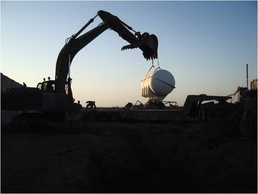
Ripping and tearing at the ancient soil of Iraq must have played some factor in the enlistment of my Soldiers. They are equipment operators and their job involves destroying and remolding the landscape of the battlefield by way of machinery and brute force with a mystique that makes young boys drool across the world. It is little wonder that transitioning this type of unit to accomplish the gentlemen's work of rebuilding a nation has some kinks worth considering. When constructing enduring structures, quality plays a more dominant role than the task of emplacing tank ditches, as most of my Soldiers are trained to execute during their AIT. One facet important to accomplishing this mission is found in the relationship between Battalion, Company, and Platoon level leaders in the quality control and quality assurance process. In order to implement deliberate quality assurance and quality control into a hasty Engineer unit, limited specific and realistic criteria must be identified and controlled during the construction process.
Quality standards should only be implemented as a means of controlling critical tasks and not to monitoring the entire process. As in all operations, there needs to be a balance between controls and independent assessment. Each project should be assessed and controlled in terms of critical function and lifespan. Unlike our civilian counterparts, who are compelled to assess the authenticity of every feature, we must scale back our requirements to only those essential for mission accomplishment. This is not to reduce the quality of our product, but to best use our assets and accomplish our missions without undue complexity, resulting in less productivity. Engineers are a limited resource. There is certainly merit in the QA/QC process seen in the United States, but it is less warranted when applied to the short term goals for most of my Platoon's projects.
On many of our projects, the key issues generally revolved around spatial location, drainage, and compaction. The way of defining success in these areas must be far simpler and allow more flexibility for on-site design change when conducted with so many unknown variables. A true design would call for an entryway HESCO separation of (X) feet. When reading a plan like this, a site manager must assume that any change to the entrance width would mean functional failure since the specification is exact and they cannot know all the factors that went into the width consideration. Since we are not building a bridge with a 100 year lifecycle that can withstand a 7.5 magnitude earthquake, the design must include more intent and reduce undue control. Perhaps all the designer wanted was an entrance that supported one-way HET traffic. A design more fitting for hasty Iraq based construction might specify function or include generous tolerances when able. I do not agree with instituting such subjective constraints that a plan looks like a Picasso, though. Exact specifications are needed to reduce complexity and define ideas, but overdesigning can bog down the leader on the ground trying to meet every requirement.
Good quality controls only exist in the absence of uncertainties. Each project contains a degree of uncertainty, especially in earthwork. Only by defining variables beforehand can an accurate control be emplaced. A prime example is in understanding the soil composition. The bearing capacity of a soil cannot be determined by looking at the earth. The recommended time to discover all the eccentricities of the project is during the recon and not the design stage. This may seem plainly logical, but it is similar to searching for a lost item without knowing yet that it has gone missing. Inevitably, issues and regrets of what should have been collected on the recon arise during the late design phase. For example, a new design requirement may bring up the issue of water-table depth and seepage resulting in water-table equilibrium. Developing a preset list of important tests and measures, despite the mission, will ensure that you are never in the dark about your projects and you have a broader picture of your site. Don't be concerned about doing it all on your own. There is no need to lug a CEE truck along every recon for a test pit to be dug when a Local National or Battle Space Owner already has your answer. Ensure that you test and recover as much information as possible from a future job site since it is common for rapid changes to come from a customer.
All measures must be easy testable in the field. Proper testing instruments are essential to implement a QA/QC plan. While having a CONEX full of testing equipment would be ideal, it is likely you will not have the ability test at your leisure. For this reason, all QA/QC requirements must put in basic terms. Instead of defining a percent compacted for soils, a hasty method that states the depth of embedment by common items can be carried out by any unit. Examining how high the sheepsfoot compactor walks on top of the soil is just one effective expedient method. When specifying grades, it becomes difficult to determine a 2% grade without an Auto-Level or handheld bulk level. If a unit is able to acquire an Auto-Level or Cone Penetrometer than appropriate training must be instituted, as these tools require a degree of perishable skill.
In order for a Battalion to have an effective quality control program it must balance control with command, define critical measures of success, and provide testable requirements linked to the successful function of each project. The exact process for executing these steps will vary between units, but the overall conclusion is that controls must be adjusted based on mission and resources on hand. The civil model of QA/QC did not fit my unit perfectly but it did get the job done to standard. Despite limitations and changing missions, an engineer is always adaptable and any task will be conquered by ingenuity.