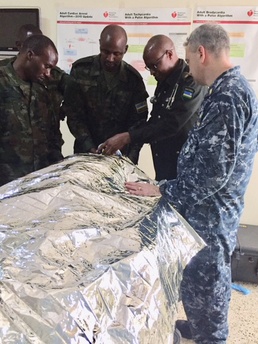
Faculty, students, and staff at the Uniformed Services University (USU) recently traveled to Rwanda to provide powerful, life-saving skills to members of the Rwandan Defense Force – skills they’ll need to protect themselves during peacekeeping operations. They also provided the Rwandans with vital tools they will need to sustain those skills.
These efforts are part of the African Peacekeeping Rapid Response Partnership (APRRP), a U.S. State Department-funded program that started in 2014 to help African partner nations develop their peacekeeping and security capabilities, initially providing training and resources to the militaries of Uganda, Rwanda, Ghana, Senegal, Tanzania, and Ethiopia.
“The goal is to enhance their ability to rapidly deploy in response to emerging crises on the continent, such as a natural disaster or a widespread Ebola outbreak,” explained USU’s Dr. Charles Beadling, the APRRP medical segment lead.
The APRRP medical component trains colleagues in these partner nations to help develop their capabilities to rapidly deploy and sustain field hospitals – United Nations (UN)-designated Level 2 hospitals that can provide primary and emergency surgical care to troops on the ground. This is an undertaking that would have significant life-saving potential, Beadling said. USU’s Center for Global Health Engagement (CGHE) was tapped to oversee all APRRP medical activities on behalf of the U.S. Africa Command, Command Surgeon to carry out these endeavors.
CGHE works to support combatant commands, like the U.S. Africa Command, in the planning and execution of their global health engagement activities to meet national security objectives, and as part of these efforts, CGHE has been involved in developing and executing a series of courses uniquely tailored to the African military audience and the APRRP mission, including medical planning and field sanitation. In January, USU Graduate School of Nursing (GSN) faculty and students, along with CGHE staff, traveled to Rwanda to provide their most recently developed course on trauma nursing.
CGHE has been working with partner African militaries to develop each of these essential courses and to identify their medical training needs and gaps in their capabilities. They found that several of the APRRP countries already participate in UN Peacekeeping Operations, including Uganda, Rwanda, and Senegal. However, some do not have the ability to rapidly deploy in an emerging crisis. Through these courses, the goal is to provide them with the skills they need to respond to a crisis within 60 days when called upon, a daunting timeframe considering the set-up and supply of a field hospital in potentially austere conditions.
In developing the APRRP courses, CGHE has drawn on expertise from across USU’s faculty and military members.
“We find the most qualified practitioners and educators to help develop each curriculum and to also serve as instructors,” said Beadling, who is also an associate professor in Military and Emergency Medicine at USU. For instance, the trauma nursing course was led by Dr. Susan Sheehy, professor in USU’s GSN and associate professor in the Department of Military and Emergency Medicine. She is known nationally and internationally for her work in emergency and trauma care. The course was also developed with the expertise of GSN faculty member Navy Cmdr. Kenneth Wofford, former GSN faculty member and retired Army Col. Paul Lewis, and Army Capt. Sarah Ashley, an Emergency Medicine fellow at the University of North Carolina.
Sheehy explained that each participant’s knowledge-base was assessed at the beginning of the four-day course. Then they were taught various aspects of trauma nursing, such as basic and advanced airway management, triage, treating special populations (pediatric, obstetric, geriatric), hemorrhage control, and how to treat burn injuries. Attendees also had a chance to practice what they learned with hands-on skills stations, and participated in a table-top triage exercise designed by USU GSN students Army Capt. Melissa Boetig and Navy Lt. Sharrod Greene.
“This is so exciting -- to provide our Rwandan nurse colleagues with these resources,” Sheehy said. “Trauma nursing skills are very important for adequate crisis response. We also incorporated a ‘train-the-trainer’ component to allow the Rwandan Defense Force to institutionalize and sustain these courses.”
During the first trauma nursing course, which took place at the Rwanda Military Hospital in Kigali, several participants were selected as candidates to become trauma nursing instructors. After completing the course, these instructor candidates then completed an additional two-day train-the-trainer component to learn how to teach the course. As new “trainers,” they taught their peers the next iteration of the course as USU collaborators stood by to assist and offer feedback. The newly-trained Rwanda nurse faculty will be able to reach out to USU subject matter experts for support whenever it’s needed. The USU/CGHE team will also return to observe the work of the new instructor candidates, making sure the courses are institutionalized and running smoothly.
“In addition to enhancing and sustaining rapid deployment medical capabilities with the African nations, APRRP provides us with the opportunity to strengthen these relationships through sustained engagements with partners of strategic security importance,” Beadling added. “By having USU lead these efforts to build sustainable medical capacity, we also have an opportunity to demonstrate and examine presumed ‘best practices’ for designing, planning, executing, and evaluating global health engagements.”
Over the next year, CGHE hopes to implement additional courses in APRRP partner nations, covering a number of other topics such as internal medicine, critical care, ultrasound, medical equipment maintenance, and medical logistics.
# # #
Story was originally posted to the Uniformed Services University’s Pulse blog site on March 5, 2018, and can be found at https://usupulse.blogspot.com/2018/03/global-health-engagement-african.html.