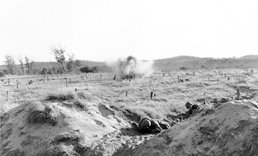
75 years ago — Nov. 20, 1943
Opening of the new Camp McCoy bus depot was scheduled for Nov. 20, 1943, said Col. George M. Macullin, post commander. Along with the new depot comes a change in policy which will see free bus transportation for soldiers inside camp.
The depot, which will accommodate several buses, was completed under the supervision of the post engineers chief, Col. H. E. Fillinger. The construction of the 20 by 150-foot depot took nearly a month. Actual use was expected to begin the following week.
The depot housed a ticket office, waiting rooms for passengers, checking and military police facilities. Checking was to be done at the depot and buses would continue on through to Sparta, La Crosse, and Tomah.
Col. H. F. Wilkinson, post supply director, whose section handled intra-camp bus services, said there would no longer be a fare for the intra-camp buses, which were driven by the supply division enlisted men. In the past, a five-cent rate had been in effect.
72 Years Ago — November 1946
A letter received from Headquarters Fifth Army ordered that Camp McCoy operate with 72 fewer people. The cut, which was effective immediately, allowed the post 245 enlisted men, a drop of 71, and 38 officers, one less than the last allotment. The total number of people authorized at the station complement was 795. The civilian strength of 500 remained the same.
This personnel allotment must be strictly adhered to. Since the post cannot exceed its authorized budget for civilian personnel, an understrength in military cannot be used to offset an overstrength in civilians or vice versa.
Due to the separation of some 100 McCoy men, an emergency requisition for approximately 40 men will be sent to Fifth Army Headquarters in order to bring the required number of enlisted personnel to the authorized ceiling of 245.
67 Years Ago — Nov. 16, 1951
Korean combat veterans stationed at Camp McCoy were the drivers of vehicles involved in 83 percent of McCoy’s fatal accidents during August through October 1951. They were the drivers of 33 percent of vehicles involved in accidents causing injury or death during the same period. The group was only 14.5 percent of McCoy’s enlisted men.
A report was released on the accidents in early November 1951 by Brig. Gen. Frederic B. Butler, McCoy’s commanding general. The report stated that during August through October 1951, five of the six Camp McCoy men fatally injured were Korean returnees. Of these five, two were passengers in cars driven by Korean veterans. The remaining three were driving their own cars when killed.
Korean veterans, usually with only 30 to 45 days having elapsed since being in the combat zone, seldom were given vehicles and were at the center for less than 48 hours. Within this time, they were either discharged or given a 30-day leave before reassignment.
Lloyd Guggenbuehl, McCoy’s safety engineer, said fatigue has been the major factor accounting for accidents involving members of the post.
30 Years Ago — November 1988
Covered in a shroud of smoke, Fort McCoy firefighter Ron Kimball tended to a fire in the boiler room of building 2170. A malfunction in the boiler caused it to explode. The explosion caused considerable damage to the building’s interior and exterior. A privately owned vehicle parked outside of the building was also damaged. The building was unoccupied at the time, and there were no injuries.
20 Years Ago — November 1998
Students from Sparta High School were helping Fort McCoy fight the invasion of glossy buckthorn, an exotic plant. The students, who were juniors and seniors, learned about the real problems that exotic plants pose to native species, plant communities, and wildlife, said Kim Mello, Fort McCoy wildlife biologist.
“Most people are unaware of the seriousness of this problem,” Mello said. “In my opinion, exotic plants are the most serious ecological problem that we are facing.”
Exotic plants are plants that are not native to an area. They were brought here by a number of methods. For example, European settlers brought plants to this country for ornamental purposes. Mello said a plant in its native habitat is kept in check by other plant or animal species that evolved with it. Those balances often don’t exist when a plant is introduced elsewhere
Glossy buckthorn is a particular threat to Fort McCoy plant species because it is a very invasive and aggressive plant, Mello said. Robins and other birds eat the purple berries that grow on this shrub and when the birds defecate, they help spread the seeds to other areas of the installation, Mello said.
To help eradicate the buckthorn plants at three of the project sites, the Sparta students either cut off the plants or pulled the plants up by the roots.
Installation staff then applied herbicide on the stump of the cut-off plant. Mello said prescribed burning also will be used as a means to control buckthorn in the spring.