By 1st Lt. Andrew B. Badgley
949th Brigade Support Battalion, 553rd Combat Sustainment Support Battalion, 10th Sustainment Brigade
CAMP LIBERTY, Iraq – As the company commander of a Convoy Security Company, "safety" is a word I hear on a daily basis. Although violence against coalition forces is at an all time low, our company must ensure every possible action is taken to mitigate the risks we face when conducting operations outside the safe zone.
The Echo Company, 949th Brigade Support Battalion, 553rd Combat Sustainment Support Battalion, 10th Sustainment Brigade, deployed to Iraq as one of the many Convoy Security Companies in the Baghdad area. The two most dangerous threats that Soldiers of Echo Company face are improvised explosive devices and vehicle rollovers. Mitigating these risks starts hours and sometimes days prior to each mission.
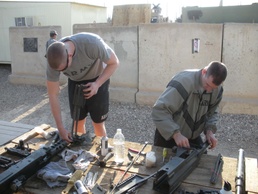
The convoy commanders ensure all of their Soldiers have the required and necessary personal protective equipment, their weapons are clean and function properly, and their vehicles are adequately prepared for the mission. Convoy commanders mitigate the risk of IEDs by gathering all possible information and intelligence for their particular mission. Using that, they develop a composite risk management worksheet with the input of Soldiers in the convoy to ensure everyone at each level is aware of both the risks and controls used to mitigate risk.
For example, one control used to mitigate the threat of IEDs is for Soldiers to study recent photographs and trigger devices used on previous IED setups. This helps them identify IEDs outside the safe zone. The composite risk management worksheet is a tool the Army uses to help leaders identify each risk and implement specific controls to lower the overall risk associated with a task.
When convoy commanders brief Soldiers on the current mission, they identify all possible risks and implement controls to mitigate them. For example, if one risk is vehicle rollovers, that risk can be mitigated by slowing the convoy speed in certain areas where the terrain is unfamiliar. Slowing the convoy speed is the control that is implemented by leaders at the lowest level in our organization.
When Soldiers complete their missions and return to the safe zone, they face a different set of safety hazards. The two most dangerous threats to Echo Company Soldiers on the camp are indirect fire and vehicular accidents. We mitigate indirect fire collateral damage by providing protection from shrapnel through concrete barriers, and we decrease the time it takes to locate each Soldier by requiring Soldiers to always move with a fellow Soldier. By practicing good personnel accountability and immediate response rehearsals, we ensure that all Soldiers know what to do and where to report.
To mitigate vehicular accidents we ensure that all Soldiers practice safe driving techniques, wear appropriate safety equipment, such as helmets, and use ground guides for parking and moving through crowded areas. One drawback is that Soldiers can become complacent when they do these activities on a daily basis.
As a commander, complacency is one of the biggest challenges I face. A day in the life of a Convoy Security Soldier can be surprisingly monotonous. He or she drives the same vehicle over the same route every day. I help them develop a sense of confidence in their abilities without instilling overconfidence that leads to accidents.
We live and work in a very dangerous place, where horrible accidents can happen daily. While a small percentage of these incidents are out of our control, we can decrease their severity by mitigating risks beforehand. As Soldiers and leaders, we must ensure that we put safety first and risk management planning into everything that we do.