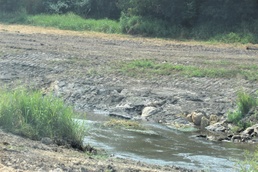
A work crew from the Wisconsin Department of Natural Resources (WDNR) used excavators to complete work on improving stream banks on South Post at Fort McCoy, Wis., as part of a continuing effort to improve waterways on post.
The work along Silver Creek is a continuing effort by the WDNR in partnership with Fort McCoy and the U.S. Fish and Wildlife Service to not only improve stream flow and erosion control, but also improve fish habitat.
At Fort McCoy, the work is coordinated with the Directorate of Public Works Environmental Division Natural Resources Branch.
Throughout the past decade, Fort McCoy has collaborated with the other agencies to improve habitat for fish throughout post, said Fisheries Biologist John Noble with the Directorate of Public Works Environmental Division Natural Resources Branch.
“There has been a lot of stream-improvement work completed here in the past that has helped improve the streams and fish habitat," Noble said. "This year’s work continues that effort.”
Five years ago, in 2013, work was completed on several barrier removal and stream-improvement projects along Ash Run and Tarr Creek in the Fort McCoy cantonment area, Noble said. In 2014, work was completed along Suukjak Sep Creek near Pine View Campground and along Stillwell Creek on South Post.
In 2015, a large project was completed on North Post to remove the Alderwood Dam and return the stream that fed into the dam to a more natural state. In 2017, a Wisconsin Department of Natural Resources (WDNR) crew performed additional work at the former dam area to improve stream banks.
In 2017, the West Silver Wetland Dam, which was located on Fort McCoy’s South Post near the Sparta-Fort McCoy Airport, was removed from Silver Creek. It was constructed in 1952. The structure required significant repair and was no longer beneficial.
“As the improvements have been made, nature takes over,” Noble said. “Brook trout and other fish species find more places to call home, extending the range of fish utilization.”
Removal of barriers also improves fish movement and helps reduce flooding at some of the stream areas, Noble said.
Learn more about Fort McCoy online at www.mccoy.army.mil, on Facebook by searching “ftmccoy,” and on Twitter by searching “usagmccoy.”